I recently got a Smartphone, thanks to the generosity of Father K and Mother K, and one that came pre-installed with a Kindle app. After about two days of playing with the Smartphone, I remembered that, "gee, Amazon lets you download works in the public domain for no money."
At which point I began a downloading binge of (less-than) epic proportions, focusing on obscure or lesser-known public domain books that I'd wanted to try. Jane Austen's Northanger Abbey , Melville's The Confidence Man, Welles' The War in the Air and The Sleeper Awakes standing as great examples [I've already read The Confidence Man, but it's short and so clever, I couldn't resist].
I also downloaded Mary Shelley's The Last Man, published about 8 years after Frankenstein, which is supposedly about a plague that wipes out humanity.
Unfortunately, though I doggedly continue reading, I've remembered why Shelley's Frankenstein, unlike Stoker's Dracula, is mostly remembered and enjoyed for the Universal and Hammer adaptations than in the original novel form. It's a problem that extends to this book as well. Mary Shelley spends a lot of time giving her characters looooong speeches about philosophy or their emotional states. She's hardly the only person of her time to have that problem (after all, she was writing for serialization and multi-volume collection), and some of the passages are decent if sentimental. But all the characters in The Last Man sound the same and their moanings and philosophical ruminations distract from a future world that is quite interesting. Unlike with Dickens, who wrote characters you wanted to spend time with even when they were doing very little, or Scott, who would throw lots of adventure and incident into each section, Shelley is rather dull.
I'm not going to claim that Shelley's predictions are accurate. Set around 2086 (in the first volume, which is where I am), she talks about lighter-than-air craft that were only "recently" discovered and seems to view England as economically and technologically about the same. Politically, the British government has abolished the institution of the monarchy (the one point on which Shelley's predictions might seem optimistic to our eyes), though the nobility is a mostly intact and substantial (if gradually waning) political force.
So, if your main criterion for reading sci-fi or judging it is how accurate the predictions are, this probably isn't the book to read. However, in this age of steampunk, it seems to me an interesting and thought-out alternate future Shelley is proposing. Once we get to the actual "everyone's going to die" parts, I'm interested to see what tropes of the disaster/post-apocalyptic genre Shelley anticipates and what tropes she ignores. After all, she lived in a time where plague was a much more real and ever-present threat than ours.
But, oh lord, someone needs to do an abridged or Classics Illustrated version of this story. I guess it makes sense that there's so much blather from the two main male characters that aren't the narrator once you realize they're based on Percy Shelley & Lord Byron (the fact that Lord RAYMOND is an ambitious asshole who gains fame fighting in Greece is a dead giveaway). But still... wanting to write fanfic about your dead husband and his best bro is not a goal that works with a vision of the future undone by a plague.
Friday, September 30, 2011

Thursday, September 15, 2011
Dear television networks:
I have an idea for the greatest show ever, that will hit all four quadrants:
Two grown-up bros, approaching middle-age, have to move to the suburbs with their daughters (who are teen witches and Mean Girls at the same time!) to uncover the mysterious past of their dead wives, who occasionally come back as ghosts to help them change their lives and/or give them sassy relationship advice. Together they all solve crimes and occasionally travel through time.
Please send all your cash monies to:
Mr. K
[Address Redacted]
Hollywood, CA
Thanks and I look forward to working with you.
Two grown-up bros, approaching middle-age, have to move to the suburbs with their daughters (who are teen witches and Mean Girls at the same time!) to uncover the mysterious past of their dead wives, who occasionally come back as ghosts to help them change their lives and/or give them sassy relationship advice. Together they all solve crimes and occasionally travel through time.
Please send all your cash monies to:
Mr. K
[Address Redacted]
Hollywood, CA
Thanks and I look forward to working with you.
Tuesday, September 6, 2011
Memoirs of an Invisible Blogger
Sorry for the sustained radio silence, geeks & geekettes. I've been very busy with a new job, attending a friend's wedding, and having my girlfriend move in with me. So, yeah, expect posting to be light for a little longer to come.
Saturday, August 13, 2011
Religion in the Marvel and DC universes
So, the wonderful and talented Wizera has decided to enter the internet blogosphere, and her post about modern-day depictions of the Olympian underworld as a Hell-equivalent reminded me of how weird the Marvel and DC universes are, where religion is concerned.
For example, in the Marvel universe, you've got the Norse and Greek pantheons, who have their own afterlives (Hel running Valhalla, Pluto running the Olympian underworld) and own special cosmology. At the same time, there is also a group called the Eternals who are clearly the basis of many of the Marvel universe's legends (and, by extension, ours) who were created by a group of alien intelligences called the Celestials who exist on a cosmological plane with a lot of other vague cosmically powered beings such as the In-Betweener, the Beyonder, the Watcher, and Galactus.*

On top of that, there are various supernatural planes, deities and forces such as Nightmare, Dormamu, Cyttorak (which is a dimension as well as a god, I believe), and the Darkforce/Living Light duality. These have frequently been shown as capable of interacting with both the mythological gods and the cosmic forces.
And there is still a Judeo-Christian cosmology and afterlife, since, for example, Doctor Doom's mother is a gypsy trapped in Hell who he frequently tried to rescue**. These afterlives might co-exist/be the same aspect of the occasional place-holder concepts meant to avoid literally saying the words Hell and/or God, etc in a mainstream publication aimed at kids. So, therefore, you have characters like Mephisto (who is clearly the Devil) at the same time as having a character whose name is Son of Satan who is the son of the actual (Judeo-Christian) Satan.***

Now, this kind of confusion is not intentional. A lot of the problem goes back to the fact, originally, that a lot of these comics were written in an age where Judeo-Christianity was assumed to be practiced by most people in America WHILE, at the same time, it was considered offensive or improper for low culture especially to name or reference religion. And more importantly, a lot of these characters were supposed to be aimed at kids or teenagers, and very few people want a young person's religious education to be from a SILVER SURFER comic (though whether their normal religious education is actually any better thought out or put-together than a given SILVER SURFER comic is a question rarely asked.)

But around the end of the 1960s/beginning of the 1970s, some writers and artists started wanting to explore the morality of comics with some level of complexity. At the same time, the Comics Code Authority started lifting some of the bans they'd had on supernatural characters, which led creators to stretch their boundaries some more.
At the same time, however, comic fans had matured. They'd grown up with characters who got their powers from Heck or fought the powers of Hades. And while they wanted to see their characters get more complex, the morality of the characters get more nuanced and adult, they also believed in the sanctity of the stories that came before.
So, while still toeing a Judeo-Christian line (as that's the ethic that pervades Western superhero comics, so that even Supergirl, after being erased by a cosmic meta-fictional entity, could show up and tell a ghost created by a pseudo-Hindu god what the meaning of Christmas was...)

Both DC and Marvel have quietly become polytheistic universes, without quite admitting or understanding it. It's like how pagan gods got co-opted by early Catholics, transformed into non-canonical saints and martyrs, or how even real saints took the place of sprites/demons/fairies/household gods in the minds of the medieval peasantry.
But hey, as a result, we can have comics where a magician gets almost killed by Satan's bastard son and then learns the secrets of the Druids from some Tibetan lamas. So there's that.
* OTOH, Galactus was supposed to be from some sort of higher plane of existence, which was destroyed by entropy, and was transformed by the shift in planes. So he actually does have a start and end date, being co-terminal with the Marvel universe instead of preceding it. And if any of you have ever read anything of Medieval philosophy and theology, you know why that's a big deal.
** For those of you new to this aspect of Dr. Doom, his mother ending up in hell had more to do with an actual deal with the devil rather than some sort of high-handed "how dare you not go to the right church" kind of thing.
*** Yes. He was a superhero in spandex and a cape, who fought evil with powers he got from being the son of the Devil. Which has to be the worst superhero origin story ever.
For example, in the Marvel universe, you've got the Norse and Greek pantheons, who have their own afterlives (Hel running Valhalla, Pluto running the Olympian underworld) and own special cosmology. At the same time, there is also a group called the Eternals who are clearly the basis of many of the Marvel universe's legends (and, by extension, ours) who were created by a group of alien intelligences called the Celestials who exist on a cosmological plane with a lot of other vague cosmically powered beings such as the In-Betweener, the Beyonder, the Watcher, and Galactus.*

See, he's a Norse demi-god fighting the forces of Hell with a machine gun.
Makes perfect sense, right?
And there is still a Judeo-Christian cosmology and afterlife, since, for example, Doctor Doom's mother is a gypsy trapped in Hell who he frequently tried to rescue**. These afterlives might co-exist/be the same aspect of the occasional place-holder concepts meant to avoid literally saying the words Hell and/or God, etc in a mainstream publication aimed at kids. So, therefore, you have characters like Mephisto (who is clearly the Devil) at the same time as having a character whose name is Son of Satan who is the son of the actual (Judeo-Christian) Satan.***

Bet you didn't know you could defeat the Devil if you just combined science & sorcery!
Now, this kind of confusion is not intentional. A lot of the problem goes back to the fact, originally, that a lot of these comics were written in an age where Judeo-Christianity was assumed to be practiced by most people in America WHILE, at the same time, it was considered offensive or improper for low culture especially to name or reference religion. And more importantly, a lot of these characters were supposed to be aimed at kids or teenagers, and very few people want a young person's religious education to be from a SILVER SURFER comic (though whether their normal religious education is actually any better thought out or put-together than a given SILVER SURFER comic is a question rarely asked.)
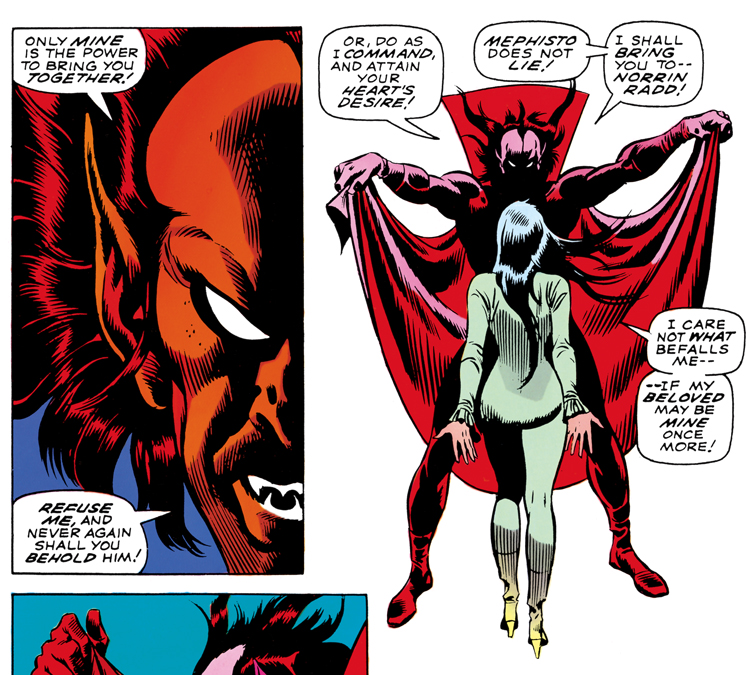
See, you can trust him because he's definitely not the Devil. Definitely not.
But around the end of the 1960s/beginning of the 1970s, some writers and artists started wanting to explore the morality of comics with some level of complexity. At the same time, the Comics Code Authority started lifting some of the bans they'd had on supernatural characters, which led creators to stretch their boundaries some more.
At the same time, however, comic fans had matured. They'd grown up with characters who got their powers from Heck or fought the powers of Hades. And while they wanted to see their characters get more complex, the morality of the characters get more nuanced and adult, they also believed in the sanctity of the stories that came before.
So, while still toeing a Judeo-Christian line (as that's the ethic that pervades Western superhero comics, so that even Supergirl, after being erased by a cosmic meta-fictional entity, could show up and tell a ghost created by a pseudo-Hindu god what the meaning of Christmas was...)

They really couldn't have timed this for Makar Sankrati instead?
Both DC and Marvel have quietly become polytheistic universes, without quite admitting or understanding it. It's like how pagan gods got co-opted by early Catholics, transformed into non-canonical saints and martyrs, or how even real saints took the place of sprites/demons/fairies/household gods in the minds of the medieval peasantry.
But hey, as a result, we can have comics where a magician gets almost killed by Satan's bastard son and then learns the secrets of the Druids from some Tibetan lamas. So there's that.
* OTOH, Galactus was supposed to be from some sort of higher plane of existence, which was destroyed by entropy, and was transformed by the shift in planes. So he actually does have a start and end date, being co-terminal with the Marvel universe instead of preceding it. And if any of you have ever read anything of Medieval philosophy and theology, you know why that's a big deal.
** For those of you new to this aspect of Dr. Doom, his mother ending up in hell had more to do with an actual deal with the devil rather than some sort of high-handed "how dare you not go to the right church" kind of thing.
*** Yes. He was a superhero in spandex and a cape, who fought evil with powers he got from being the son of the Devil. Which has to be the worst superhero origin story ever.
Wednesday, July 27, 2011
Writer makes disappointing directorial debut. Also, dog bites man...
STITCHED (2011)
Directed by Garth Ennis
Starring Tank Jones, Lauren Alonzo, and Kate Kugler
Synopsis: The survivors of a crashed American chopper in Afghanistan face a greater threat than the Taliban when they are set upon by a seemingly invulnerable army of the undead. And then the SAS shows up...
I blow hot and cold on Garth Ennis. On the one hand, he has written some great and compelling comics (Punisher: The End, Punisher: The Tyger, Preacher, Hitman). On the other hand, he's a writer whose aesthetic interests I increasingly find hard to separate from his limitations. He writes the foul-mouthed badass & the strong, stoic man of action very well, but writes characters he doesn't agree with or respect as the most contemptible straw men. And sometimes his admiration of tough men making hard choices easily shades into fascism.
So, Garth Ennis making his directorial debut on a short film about soldiers in Afghanistan encountering a supernatural power more evil than the Taliban? Oh, and produced by the people at Avatar (a company that, for every good book it puts out, puts out seventeen stolen from Warren or Alan or Garth's commonplace books)? If it wasn't for the fact that chances to see this outside of Comicon were going to be rare, I probably wouldn't have lined up for it. And a small part of me hoped that Ennis, pushed into a new medium, out of his comfort zone, might do something interesting.
Unfortunately, Stitched isn't even an intriguing misfire. It's just a bore.
The writing isn't the problem, though what comes across on the comics page as clever exposition feels awkward coming out of a real person's mouth sometimes.
The bigger problem is that Ennis just doesn't have a grasp on how to do film. His time as a comic book writer has clearly taught him how to think visually, but the fact he doesn't have to execute those visuals means that good ideas are botched. The carnage of a previous battle that the soldiers stumble across is filmed in such a flat, matter-of-fact way that it comes across as a joke more than a horrific moment. And not a dark joke, but a Zucker-Abrams-Zucker joke.
A better example is a sequence of the soldiers climbing a hill. The soldiers are shot from behind and below as they ascend. It's a good idea either to sell the tiring nature of their trek or to give a mythic image to these tired warriors. In practice, the shot is framed and lit with the minimum amount of attention possible, and instead looks like a series of asses jouncing up a hill.
But the biggest problem is that Ennis can't direct actors. While it's hard to assess from the IMDB resumes of the stars how talented they are, the fact that all the line-readings are given with a similar lack of inflection, as if the scripts were handed to them five minutes before the shoot started and they were told this was merely a read-through. While Jones and Alonzo are poor actors, a special Razzie should be given to Kugler, who manages the amazing feat of being both dull and infuriating in her portrayal of a shellshocked PTSD soldier as a whiny teenager whose parents aren't letting her go to the mall.
Note to directors: stylized dialogue requires special attention to actors to make it work. Note to Garth Ennis: your dialogue is stylized.
If I sound so annoyed, it's because the monsters at the center of the short film are so fascinating. They're similar to zombies in that they are slow, stupid and can't use tools. And like traditional zombies, they're dangerous due to their numbers and tenacity as much as anything. But the visual, of creatures with every hole in their face (eyes, nose & mouth) stitched shut, who stumble along like the Templars from Tombs of the Blind Dead, is amazing. And Ennis' conceptual twists on these creatures (they can't be killed with a shot to the head or severing of the spine, for example) suggest a fascinating mythology.
But all of that is hidden inside a boring, indifferent film whose main purpose, at this point, is to serve as an extended trailer for the inevitable Avatar Press ongoing. Color me unimpressed.
Directed by Garth Ennis
Starring Tank Jones, Lauren Alonzo, and Kate Kugler
Synopsis: The survivors of a crashed American chopper in Afghanistan face a greater threat than the Taliban when they are set upon by a seemingly invulnerable army of the undead. And then the SAS shows up...
I blow hot and cold on Garth Ennis. On the one hand, he has written some great and compelling comics (Punisher: The End, Punisher: The Tyger, Preacher, Hitman). On the other hand, he's a writer whose aesthetic interests I increasingly find hard to separate from his limitations. He writes the foul-mouthed badass & the strong, stoic man of action very well, but writes characters he doesn't agree with or respect as the most contemptible straw men. And sometimes his admiration of tough men making hard choices easily shades into fascism.
So, Garth Ennis making his directorial debut on a short film about soldiers in Afghanistan encountering a supernatural power more evil than the Taliban? Oh, and produced by the people at Avatar (a company that, for every good book it puts out, puts out seventeen stolen from Warren or Alan or Garth's commonplace books)? If it wasn't for the fact that chances to see this outside of Comicon were going to be rare, I probably wouldn't have lined up for it. And a small part of me hoped that Ennis, pushed into a new medium, out of his comfort zone, might do something interesting.
Unfortunately, Stitched isn't even an intriguing misfire. It's just a bore.
The writing isn't the problem, though what comes across on the comics page as clever exposition feels awkward coming out of a real person's mouth sometimes.
The bigger problem is that Ennis just doesn't have a grasp on how to do film. His time as a comic book writer has clearly taught him how to think visually, but the fact he doesn't have to execute those visuals means that good ideas are botched. The carnage of a previous battle that the soldiers stumble across is filmed in such a flat, matter-of-fact way that it comes across as a joke more than a horrific moment. And not a dark joke, but a Zucker-Abrams-Zucker joke.
A better example is a sequence of the soldiers climbing a hill. The soldiers are shot from behind and below as they ascend. It's a good idea either to sell the tiring nature of their trek or to give a mythic image to these tired warriors. In practice, the shot is framed and lit with the minimum amount of attention possible, and instead looks like a series of asses jouncing up a hill.
But the biggest problem is that Ennis can't direct actors. While it's hard to assess from the IMDB resumes of the stars how talented they are, the fact that all the line-readings are given with a similar lack of inflection, as if the scripts were handed to them five minutes before the shoot started and they were told this was merely a read-through. While Jones and Alonzo are poor actors, a special Razzie should be given to Kugler, who manages the amazing feat of being both dull and infuriating in her portrayal of a shellshocked PTSD soldier as a whiny teenager whose parents aren't letting her go to the mall.
Note to directors: stylized dialogue requires special attention to actors to make it work. Note to Garth Ennis: your dialogue is stylized.
If I sound so annoyed, it's because the monsters at the center of the short film are so fascinating. They're similar to zombies in that they are slow, stupid and can't use tools. And like traditional zombies, they're dangerous due to their numbers and tenacity as much as anything. But the visual, of creatures with every hole in their face (eyes, nose & mouth) stitched shut, who stumble along like the Templars from Tombs of the Blind Dead, is amazing. And Ennis' conceptual twists on these creatures (they can't be killed with a shot to the head or severing of the spine, for example) suggest a fascinating mythology.
But all of that is hidden inside a boring, indifferent film whose main purpose, at this point, is to serve as an extended trailer for the inevitable Avatar Press ongoing. Color me unimpressed.
Wednesday, July 20, 2011
Stop talking about comic books or I'll kill you...
I'm heading to Comicon. Posting to resume after I return!
Sunday, July 10, 2011
Because Eve Tushnet always has such interesting posts...
Eve challenged her readers to think of Christian films and atheist films for hypothetical film festivals. Apparently, it's been easier for her readers to think of atheist films than Christian ones.
For the purpose of this post, she's talking about films that represent those worldviews, not necessarily films made by Christians or atheists.
Christian films
The Trial of Joan of Arc (d. Robert Bresson) - Not just because the subject is Joan, but because Bresson is focused on the suffering and humility of Joan, even her very human weaknesses, and her faith enables her to endure and transfigure those elements of her life. That transfiguration is the miracle we see in the film, not some fantastic magic trick (which is how film usually defines them).
Love Exposure (d. Shion Sono) - Actually, this film can probably be interpreted multiple ways. And while there is a fair amount anti-religious material here, it's notable that the worst behavior is of people who turn religion to their purposes. The hypocrites and those without humility are those that cause the most suffering, and it is love (both secular & religious) that gives the male protagonist the strength to struggle on against a world that is turned against him. It's also about the way that outcasts can find fellowship & express Christian brotherhood for each other. I'd love to see Eve's reaction to all the complex & weird ideas about religion, love, gender & sexual orientation that overflow this film.
Terri (d. Azazel Jacobs) - This film, focusing on an intelligent, perceptive but troubled boy & his attempts to reach out to the world, deals with the injustice and pain of engaging with a flawed world and the broken, foolish people who inhabit it. Despite all the heartache and pain that engagement brings, the movie shows us the need to reach out to our fellow sufferers and sinners, since only that outreach can shape our suffering and pain into something better.
That's all that I can think of, off the top of my head, at the moment. But there are two relatively recent films and one older film that promote a Christian humanist worldview, to balance out all those despairing films Tushnet & her readers have thought of so far.
For the purpose of this post, she's talking about films that represent those worldviews, not necessarily films made by Christians or atheists.
Christian films
The Trial of Joan of Arc (d. Robert Bresson) - Not just because the subject is Joan, but because Bresson is focused on the suffering and humility of Joan, even her very human weaknesses, and her faith enables her to endure and transfigure those elements of her life. That transfiguration is the miracle we see in the film, not some fantastic magic trick (which is how film usually defines them).
Love Exposure (d. Shion Sono) - Actually, this film can probably be interpreted multiple ways. And while there is a fair amount anti-religious material here, it's notable that the worst behavior is of people who turn religion to their purposes. The hypocrites and those without humility are those that cause the most suffering, and it is love (both secular & religious) that gives the male protagonist the strength to struggle on against a world that is turned against him. It's also about the way that outcasts can find fellowship & express Christian brotherhood for each other. I'd love to see Eve's reaction to all the complex & weird ideas about religion, love, gender & sexual orientation that overflow this film.
Terri (d. Azazel Jacobs) - This film, focusing on an intelligent, perceptive but troubled boy & his attempts to reach out to the world, deals with the injustice and pain of engaging with a flawed world and the broken, foolish people who inhabit it. Despite all the heartache and pain that engagement brings, the movie shows us the need to reach out to our fellow sufferers and sinners, since only that outreach can shape our suffering and pain into something better.
That's all that I can think of, off the top of my head, at the moment. But there are two relatively recent films and one older film that promote a Christian humanist worldview, to balance out all those despairing films Tushnet & her readers have thought of so far.
Subscribe to:
Posts (Atom)