The post below contains my thoughts on Edward Dmytryk's Crossfire. This was one of the films I considered posting about for the Film Noir blog-a-thon, but didn't have enough original thoughts to bring it to a full post.
However, Ed Howard did end up writing a wonderful post about Crossfire. And, luckily for me, one of his thoughts, regarding the fact we know the culprit for the inciting murder relatively early on, plays into some of my thoughts on the performances in the film.
As I argue below, the tension for the film comes not from the mystery of who the killer is, but whether our heroes will let him get away with his crime.
Thoughts below the break...
Showing posts with label blog-a-thon. Show all posts
Showing posts with label blog-a-thon. Show all posts
Tuesday, March 1, 2011

Monday, February 14, 2011
"We do not make mistakes!" HANGMEN ALSO DIE (1943)

d. Fritz Lang
Starring Brian Donlevy, Walter Brennan, Anna Lee and Gene Lockhart
A while back, the talented David Cairns posted an excellent tribute to the obscure noir/WWII film THE DEVIL STRIKES AT NIGHT by the German transplant/film director Robert Siodmak. It's an amazing reversal of audience sentiment, drawing us in with a traditional procedural, then reversing our sympathies and expectations by having the procedural aspects conducted by the Gestapo. It ends up being a damning condemnation of Nazi Germany because of the way even the most normal and necessary elements of civilization get perverted in the name of racist ideology and a refusal to confess weakness.
By the end of Hangmen Also Die! (one of two Hollywood efforts to dramatize the assassination of Reinhard Heydrich) Lang's direction and Brecht's script accomplishes a similar feat. Instead of perversely wishing that the Gestapo actually succeed in their goal of catching a man, I find myself sympathizing with a Nazi collaborator and traitor who is being pursued and prosecuted for a crime he never committed. Even though this man is complicit in the regime's crimes, we see the ways in which an ideologically corrupt government ends up obliterating the one man who should offer them no threat.
Some credit should also go to Gene Lockhart, who portrays his Quisling brewer Emil Czaka in a way that makes us despise him when he is riding high on the Nazi bandwagon, but whose very childish selfishness makes him pitiful when the world stops making sense. He's certainly evil and we want him punished, but, like Kafka's narrator in The Trial, we remember that feeling of guilt and the worry that whatever we're being punished for, it's for that crime that no one knows.
The complicated element, however, is that this is the thing that sticks with us at the end, the Quisling, the monster, being hunted down by his own kind, reality turned against him.

There certainly are a lot of intentional echoes of M in the end.
[ Sidenote: Record shows that Brecht was quite dissatisfied with this film, the only film project of his Hollywood years to reach completion. He felt that the script was watered down and the film was buried. Certainly the imbalanced nature of the film suggests he was right. On the other hand, Brecht the theorist often contradicted the results of Brecht the author. We need merely look at Mother Courage and Her Children for an example of how they disagree. The theorist thinks Mother Courage is a ridiculous, even monstrous figure at the end of the play, but the author has created someone we pity and admire.
Looking at the picture as a piece of the Brecht canon, there certainly are a lot of elements that strike me as Brechtian. Ideologically, the film is obsessed with the importance of mutual cooperation and, more importantly, the way the needs of the many outweigh the desires and petty moralities of the few. Again and again, a character is forced to embrace a behavior that is normally wrong, such as Nasha faking unfaithfulness or Svodoba refusing to take responsibility for his actions, because of the greater need of the group.
Also, there is a keen insight into the way groups and hierarchies function that represent the Brechtian fascination with the street scene. The opening, in which a crowd of industrialists and bureaucrats argue as they wait for the Reichsprotector, for example, highlights the contradictory impulses and desires of the toadies in the corporatist fascist state in an efficient and telling way. The same in a street scene where Anna Lee's attempts to reach Gestapo headquarters is discussed by the community, which then bands together to ostracize her.]
That's not to say that the rest of the film is bad or uninteresting. Fritz Lang is directing with James Wong Howe as his DP! The whole film plays out in a real world played by people so varied and homely in appearance (even our leads, when they are good-looking, are of boys and girls next door type) that even the smallest part is given the lived-in feel of a sketch or a woodcut.
And there really is an amazing visual eye and design sense to the film, like in a Gestapo investigator's office that is filled with clearly looted furniture and art mingled with shabby office furniture, or a horrifying series of sequences in Gestapo headquarters that pave the way for Orwell's description of similar spaces in 1984.
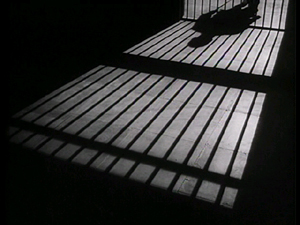
One of several arresting images from the Gestapo HQ sequence.
There's so much to talk about here, from the daring and effective decision to have the Germans speak in German while the Czechs speak English, to the weird sense of dissonance brought on by Walter Brennan pretending to be an intellectual European when you want him to be croaking at John Wayne, to the way that Alexander Granach's Gestapo officer comes off as a perverse, sadistic but compelling version of Hercule Poirot.
But I'd rather encourage you to watch the film yourself and come back and leave your thoughts in the comments. It really is an amazing, under-rated film that deserves further exposure.
This blog post is part of the For the Love of Film (Noir) Blog-A-Thon, which is raising money to restore the influential but obscure noir The Sound of Fury. If you are interested in donating to this important cause, click here.


Monday, February 7, 2011
Coming soon to a blog near you...
I know I haven't been updating much lately, despite having a lot of awesome things happen and seeing a lot of awesome movies.
However, I have promised to participate in the brilliant and charming Self-Styled Siren's For the Love of Film Noir blog-a-thon (link to donate to the restoration of a great noir film here).
I'm choosing between one of two films. Haven't quite decided which to post. Hint: one involves three actors named Robert and anti-semitism, the other involves a Nazi anti-hero.
More content soon, I promise!
However, I have promised to participate in the brilliant and charming Self-Styled Siren's For the Love of Film Noir blog-a-thon (link to donate to the restoration of a great noir film here).
I'm choosing between one of two films. Haven't quite decided which to post. Hint: one involves three actors named Robert and anti-semitism, the other involves a Nazi anti-hero.
More content soon, I promise!
Tuesday, December 14, 2010
An epic problem's not a problem for me: 55 DAYS AT PEKING (1963)
Starring Charlton Heston, Ava Gardner, David Niven, John Ireland and a bunch of white people in yellowface make-up (including poor Robert Helpmann)
I better start off by admitting I've never seen King of Kings. I know Nicholas Ray as the guy who made Johnny Guitar and Rebel Without a Cause (among others). And they're big films, epic emotionally and physically, but still personal.
55 Days at Peking
 doesn't feel personal. It feels like a Samuel Bronston production. Mr. Cairns, whose Late Show Blog-a-thon I'm piggy-backing on, has already gone into Samuel Bronston's gift for Spanish tax shelters and destroying talented auteurs from the '50s (poor Anthony Mann
 ). (At least Uwe Boll's main artistic victim is himself.)
And we're back in Spain (here playing Peking), with star Charlton Heston
 , and now it's poor Nicholas Ray having a heart attack trying to dramatize an epic historical event.
And it certainly feels like the kind of film that would give someone a heart attack. In most of the crowd scenes, the details are way too busy, overwhelming the eye and the attention, to the detriment of the story and shot composition. Eventually the story itself overwhelms any attempt at characterization by about an hour and a half in (about the time the intermission ends), and characters disappear for long stretches of time, to be replaced by explosions and extras. Spectacle qua spectacle just drains you, weakening previous effective scenes with repetition.
There are some nice grace notes, especially in the first part of the film. When Ray (or whoever is behind the camera) is shooting a couple of people together, it can be very effective. There are two scenes practically back-to-back about an hour and fifteen minutes in which first Heston's character and then Niven's character are put through the wringer as they risk losing someone they love to combat. Heston actually emotes in a subtle way, battling back a mix of prejudice, anger and despair as he tries to tell a half-Chinese girl her American father is dead. And it's framed in a half-ruined church, with a priest checking in from over an altar, in half-light.
On the acting front, Ava Gardner is flirty and beautiful, Charlton Heston is comfortably being Charlton Heston and Robert Helpmann, so wonderful in The Red Shoes and The Tales of Hoffman, decides to try out for a role as Republic serial villain.

Robert Helpmann will finally crush Flash Gordon!
David Niven's the one who comes out of this film smelling like roses. It helps that his character is the most complex. He's a good husband, a loving father, and a talented diplomat; he's charming and friendly even to someone as frustrating as Heston's Major Lewis. But in the name of peace he's willing to risk the lives of everyone in the foreign sector, including innocent civilians, and we already know his larger goal of preventing large-spread violence is going to fail.
An interesting sidebar: I wonder if this film could have been released any time other than 1963. Earlier than that and too many people might been bitter about the Korean War to want to see a movie about China's first fight against the West. Make it so much as a year later, and too many people would have seen uncomfortable parallels with what was going on in Vietnam. The muddled politics would have probably made it too hard for either side, left or right, to cheer it on (unlike, say, The Ballad of the Green Berets). As it is, when Heston's Marine says something like, "I'm just a soldier patrolling rice paddies in the back country" before demanding more soldiers, I get an uncomfortable shudder knowing what is coming down the pike for '60s America.
Anyway, the Boxer Rebellion ought to be a dramatically interesting subject for a movie. The problem is that this film is wedded to a "oh no, these white people are in danger" story-line that really limits it. Perhaps the problem is that, after a certain point, all the initiative and maneuvering is taking place in other military camps or in the Forbidden City, so that we only see our heroes reacting to things. The plot itself becomes a war of attrition on our attention, which is thematically appropriate but rather boring when it happens unintentionally.

I'm pretty sure they stole this shot for Ghostbusters.
Maybe part of it is just that I keep thinking a movie about the Peking embassies trying to maintain their Western way of life in the face of logistical and political impossibilities on the eve of the Boxer Rebellion would have been a fascinating film. But it's not one that would have starred Charlton Heston and Ava Gardner, let's be honest.
So we get a happy ending where a multi-national force marches in to strip China of its autonomy and Charlton Heston reaches out his hand from astride a horse to a little half-Chinese girl (who is really us, we all suddenly realize in the audience as the horns toot and strings swell and a supporting character gives an approving glance) and offers to give her a ride back to America.
But then again, there's a strain of cynical irony deep down in the grain of the film as we hear Russian aristocrats and Austro-Hungarian diplomats talking about imposing their will on China, not realizing they'll be in the dustbin of history in less than two decades. Or when Heston and Gardner flirt and waltz in an ancient temple, as an austere, ageless, uncaring Buddha stares down at them, knowing that this too shall pass. People come and go, but they won't stay. Nations come and go. Trends come and go.
And an exhausted Charlton Heston, worn out from a day of subduing natives, will collapse on his bed, a cross between the pieta and the dying Marat, and that little half-Chinese girl will look out from behind the rubble, afraid to approach. And she waits.
Tuesday, April 20, 2010
"I can't do this anymore": Lost, season 2, episodes 19
"S.O.S."
Synopsis: Jack decides that they should try to trade Henry for Walt. Meanwhile, Bernard tries to work towards rescue by building a giant SOS on the beach. When Jack and Kate go out into the jungle to the line to meet with the Others, however, the person that greets them is not who they'd expect.
After the last few episodes, which have fallen a little flat on the character front, we get what is a quieter episode but a more successful character-based one. Bernard and Rose, despite doing very little, somehow seem to matter a lot just because they are one of the island's successes. And what's fascinating about this episode is that Bernard and Rose's problems don't arise from resentment or hatred or disappointment, but from their own love.
So after a very sweet meeting that also encapsulates both characters' approaches to life, Bernard and Rose fall in love. Bernard proposes to Rose, only to learn that she has cancer and it's pretty much untreatable. But whereas Rose has accepted this, Bernard thinks he can fix it with a faith healer in Australia.
Now, in the present, Bernard wants to get them rescued while Rose just wants to settle in to the island. And Bernard's need to do something and Rose's acceptance of life's troubles are what the other one needs and finds charming, but unless they find some middle ground, it will also destroy them. Bernard's drive leads him to waste valuable time, but it's also what makes him still want to commit to what could be a very dire and draining marriage with a terminally ill woman. Rose's acceptance means she doesn't reject Bernard, but it also means that she'll just accept their issues without confronting him.
And once Rose actually confronts Bernard, revealing to him that it's not the faith-healer that cured her, but the island itself, then he can see that what he needs to do is be with her, not affect a rescue.
The whole storyline is very well handled, and the actors playing Rose and Bernard really sell what could be overly sentimental by letting the tiredness and disappointments in life play across their faces. Neither of their plans is made in ignorance or denial, but because their lives have led them to places where they think that is the best way to struggle on.
Grade: A
Other Comments
- The show's approach to religion and the supernatural is interesting. I don't think we've seen anyone with religious or spiritual faith who isn't motivated to something greater by it or at least treating it as an honest calling. For example, you'd think the faith healer (a Patrick Stewart look-alike) would be a charlatan, but instead he genuinely believes in what he's doing and offers to return money that's been donated when he can't affect a cure. And he turns out to be right in his way.
- I think it helps soften Bernard by showing him talking to that girl on the crutches as Rose is with the healer. Nice moment that shows why Rose loves him, even as she makes a decision that could really haunt them both.
- The Island is starting to strike me as some sort of giant immune system, like something out of Grant Morrison. Everyone who comes there in crisis finds their buttons pushed by the Island itself and they either heal or die. Or they heal and then die.
- On the other hand, really sucks for someone like that guy who broke his leg with the Tailies. Or Boone. Why didn't the Island help heal them?
- I like Kate's fiery nature coming out at Jack in this ep. From the annoyance she expresses about being kicked out of "the club" to her apology for kissing him... and Jack kind of deserves it.
- So they're building a church? Hmm... Plus, Charlie gets a replacement savior in Eko!
- So what happens when the amount of people who want to stay are about the same size as the group that wants to be rescued?
- And Michael Emerson barely says or does anything in this episode, but every moment he's on, you don't want to look away from him, hoping for some sign of something.
Quotes:
- Hurley: "We built a raft...That got blown up."
- Bernard: "Where's Craig? Where's Frogurt?"
- Kate: "Gonna waste another bullet?"
Jack: "We'll still have 13 more to shoot each other with."
- Bernard: "We won't ever leave, Rose."
- Also Bernard: "I would offer to take down the sign, but we didn't get very far."
Friday, February 5, 2010
"I'm sorry you had to see me like that": Thoughts on Lost's Season 6 premiere
Now, the problem with blogging about the premiere of Season 6 of LOST at this point is that all these smart people on the internet have commented (along with some stupid people).
For examples of stupidity, see Jack Shafer at Slate's response & Salon's write-up. I can understand the critics' not relating to the characters anymore, but not the vitriol directed at the actual narrative concept of parallel universes. Admittedly, you don't see it that much in the mainstream, but it was used in Sliding Doors for crying out loud, which is hardly art-house cinema! If TV critics have their minds blown by this idea, then that says something very sad about the poverty of imagination in television. Does Jack Shafer explode with rage when he reads Phillip K Dick or see the last scene of 25th Hour?
As for me, I wasn't bothered by the parallel reality storyline. Personally, the narrative that grabbed me was the one in 2007 on the Island, but it was nice to revisit with some of the cast members lost in previous seasons and get gentler moments with even the current cast members. There was something strangely moving about seeing Locke & Jack actually connect, after seasons of seeing them argue & both move in douche-ier directions.
And while I don't agree with "Darlton"'s claims that this new season is accessible, I can see what they're getting at. In one timeline, you've got all the sort of sci-fi/fantasy/mystery elements that get the theorists & wonks going. In the other, you've got a return to the character-based soap-opera of the first season and a half.
Of course, each timeline contains both those elements to some extent. But if you hate all the Dharma Initiative/Others stuff, you can enjoy Jack-and-Locke daddy issue theatre!
But I enjoyed both. And it was interesting how the two contrasted. For some reason, the 2004 timeline felt desaturated & washed out, while life itself had a sordid quality. As much as the character of Kate still annoys me, the change from selfish fugitive (who takes a pregnant woman hostage) to take-charge adventurer was a change for the better. The same with Charlie's growth from self-destructive addict to brave martyr. I think you can argue both sides of these people are inter-related (in both realities, Charlie searches out death, but at least in the 2007 reality, he died for something worthwhile), but they show growth.
Wrapping this up now, so onto my comments:
- Love Flocke/Smokey. Terry O'Quinn certainly gets his fair amount of show-off time, but his delivery of "I'm disappointed in all of you" hits several notes at once (sincere disappointment, anger, parental condescension) that most actors would be hard-pressed to match.
- I'm starting to feel like the writers don't know what to do with Sun & Lapidus anymore. It's especially disappointing with Sun, who is probably one of the most complex characters in the show, but she keeps on getting dragged along in other peoples' schemes. My disappointment with Lapidus' treatment is more at the waste of Jeff Fahey's considerable talents.
- Woohoo! John Hawkes! I thought he looked familiar, but it's to his credit that I couldn't place him as Sol Starr, who is not that different a character, but is expressed in such a different way.
- I think the writers have a plan with Man-in-Black & Jacob, but I'm still not completely sure how the survivors' experiences have been shaped by both. I'm guessing all the ghosts have been agents of MIB, except a good portion of their advice has been benign. Whereas Jacob seems friendlier, but some of his assistance in the real world (saving Sayid but not his wife, encouraging Sawyer's hunger for revenge) actually has a darker tone. And why is Smokey active in the Outer Temple when the people of the Inner Temple want to & know how to keep him out?
- Also, what is the relationship between the Dharmaville Others & the Temple Others? Cindy, Zach & Emma were with both, but Alex didn't know about the Temple. Why has Richard's group been camping out in the woods for three years (since they clearly didn't return to Dharmaville) when they could be at the Temple?
- I think criticism of the Oceanic survivor's Jughead plan as selfish is a little harsh. Short-sighted, yes, but bombs don't SINK islands. Also, it's not just that Jack/Kate & Sawyer/Juliet are unhappy. Almost everyone that crashed with them is now dead, as are Faraday & Charlotte & almost all the other Freighties. Plus Rousseau, Alex, Nadia, a large portion of the Others & at least a few of the passengers of Ajira 316 (though that last group the 1977 people didn't know much about). In the face of that, it is hard to remember how the Island has positively effected them.
Wednesday, January 27, 2010
"No, I'm done lying": Lost blog-a-thon, Season 2, episode 18
"Dave"
Synopsis: Hurley starts seeing a "friend" named Dave from his time in the mental institution on the island. Dave tells him this entire experience is a figment of his imagination. Meanwhile, Locke finds himself pushed to the sidelines as Jack, Sayid and Ana Lucia deal with the false Henry Gale.
So a friend of mine from college recently sent along a bunch of in-development scripts from major studios. And one of them was a pretty loathsome horror film about some cooking staff trapped in a mental institution during a power outage. And part of the loathsomeness stemmed from the fact the horrific suffering seemed pointless. But the thing that got me was that the inhabitants of the asylum were monolithical, one-dimensional crazies, capable of absurd evil with no rhyme or reason to their affliction. It acted as if Arkham Asylum were meant as a realistic depiction of mental illness and it was kind of sickening.
So, kudos to this episode for avoiding that. Whatever else you can say about Hurley, Lost's writers and Jorge Garcia have never treated him as less than a whole human being. We see him as a nice guy (in some ways, he's the nicest character in the main cast, a fact which the character of Rose acknowledged in-show) and his mistakes usually end up hurting only himself. Compare that to Charlie, whose sympathetic issues have pushed him into incredibly dark territory in recent episodes this season.
But, you know, I called the main twist really early in. I've seen too many horror/fantasy films that rely on unreliable memory or dreams to know that if no one else directly interacts with a character except for one person, he's a ghost/imaginary friend/alternate personality.
That's not to short Evan Handler's work as Dave. He exudes malevolence, but of a very earthly kind, that of that one asshole friend who sort of gives you an adrenaline rush through his asshole-ness.
So too the character of Hurley and our genuine concern for him keep us interested. And his sort-of-breakdown causes one of the best moments of the episode, when he administers a very public beatdown to a surprised Sawyer.
And for a few moments, the double-bluff that the writers play that this might, for once, actually be all in Hurley's head hold power. But despite the clues (not all of them pointed out by Dave, to be fair, which increases the likelihood of them being true), a St. Elsewhere kind of ending after we've become invested in all these characters would make people worldwide want to destroy their TVs. Even with the extra twist ending at the end.
Frankly, the Hatch plot is much more interesting. I like how Locke is struggling against what seems like fate trying to pull him back to his pre-crash life. The other survivors don't know how dismissive they're being, but the episode really gets his POV across, as he lies on the bed and waits for people to tell him what that gunshot was for.
Grade: B-
Other Comments
- So, that's Senator Kelly (Bruce Davison) as Doctor Burke. I really hope he doesn't twig to the fact Walt's a mutant.
- And yes, the poster on his office wall looks a lot like the Island. So, points to you, deranged figment of Hurley's imagination!
- I like that Hurley and Libby's relationship, for all it's gentleness, has a slightly disturbing side. Is she in love with him or in love with fixing him (just like Jack with his ex-wife)?
- Also, John Locke is really having a bad day. Down to one good leg, then your sense of purpose gets taken away? Harsh.
- Also, Dave leads Hurley through the wilderness, through a garden, to a cliff and promises Hurley a new world if he just jumps. See, it is this symbolism that stacks the deck too heavily against Dave for us to believe him.
Quotes
- "God doesn't know how long we've been here, John. He can't see this island any better than the rest of the world can." - "Henry"
- After Libby suggests the survivors will share food of their own accord: "Great plan, Moonbeam, and after that we can sing 'Kumbaya' and do trust falls." - Sawyer
- "Don't you have an adventure to get to? I think Timmy fell down the well over that way." - Great ep for Sawyer quotes.
Friday, January 15, 2010
Sonic Weapon Fence actually does make a good name for a band
So that post below, the LOST recap, that is one of several orphans from when I planned to do this whole LOST recap-blog-a-thon, since there wasn't much dedicated coverage, episode-by-episode, on the AV Club or my favorite parts of the interweb.
I didn't follow through with the entire thing, but I did write up maybe five or six more episodes, which will also be posted here over the next couple of weeks.
Because (and I know, I'm burying the lede), I have both finished LOST up through season 5 AND just in time too. Season 6 starts February 2nd, and while I'm unsure if I'll be able to watch that night (it's complicated), I am impatient for the chance to see it.
And so my posting might be a little LOST-centric over the next couple of weeks remaining. I've got a LOST drinking game that I joked about on twitter, along with a couple of thoughts on what LOST means to me and TV going into a new decade. And maybe I'll watch the Rifftrax version of the LOST pilot.
Until then, listen to some Sonic Weapon Fence, who are a pretty good band for a novelty, tv-themed band and who I recommend over Previously on Lost.
I didn't follow through with the entire thing, but I did write up maybe five or six more episodes, which will also be posted here over the next couple of weeks.
Because (and I know, I'm burying the lede), I have both finished LOST up through season 5 AND just in time too. Season 6 starts February 2nd, and while I'm unsure if I'll be able to watch that night (it's complicated), I am impatient for the chance to see it.
And so my posting might be a little LOST-centric over the next couple of weeks remaining. I've got a LOST drinking game that I joked about on twitter, along with a couple of thoughts on what LOST means to me and TV going into a new decade. And maybe I'll watch the Rifftrax version of the LOST pilot.
Until then, listen to some Sonic Weapon Fence, who are a pretty good band for a novelty, tv-themed band and who I recommend over Previously on Lost.
Subscribe to:
Posts (Atom)