Modesty Blaise (1966)
d. Joseph Losey
Starring: Monica Vitti, Terrence Stamp, Dirk Bogarde, and Clive Revill
If there is one silver lining to wearying but banal illnesses like a cold or the flu, it is the way they justify catching up on one's movie viewing, especially lightweight cinematic confections. I might not be interested in watching Salo right now, but something like Modesty Blaise or a giallo or a minor '40's b-movie is right up my alley.
And Modesty Blaise is good. Not great, but definitely good. From the buzz (or lack of it), I expected to find something like the atrocious 1967 version of Casino Royale. Instead, it could sit comfortably alongside Mario Bava's Danger: Diabolik. Just like Bava's film, MB is a comic book caper that is definitely more style than substance, but that style...
Sunday, February 27, 2011

Saturday, February 26, 2011
I'm listed MIA...
Whoah, thanks to everyone who checked out my post on Hangmen Also Die! as part of the For the Love of Film Noir Blog-a-thon.
I've got some follow-up posts in the works, but I spent last week in Chicago, and this week was spent with me drained by the twin demons of poor health and day jobs.
But on the positive side, I've now got a blu-ray player that is Wi-Fi enabled, so I'll be watching Netflix even more easily now. And I also ordered Warner Archive's version of The Outfit, so hopefully a review of that will be up soon.
In the meantime, I recommend my cinephile friends check out Walter Hill's little-remembered Extreme Prejudice (1987). Scripted by John Milius, starring Powers Boothe, Nick Nolte, Rip Torn, Clancy Brown, William Forsythe and Michael Ironsides, it really deserves to be better remembered. It's a very strange and uneven film, but it hangs together much better than you'd expect. It really strikes a fascinating balancing act between neo-western and action-thriller, with the tension between the two genres serving as a thematic emphasis on the way the American spirit/character has changed.


I've got some follow-up posts in the works, but I spent last week in Chicago, and this week was spent with me drained by the twin demons of poor health and day jobs.
But on the positive side, I've now got a blu-ray player that is Wi-Fi enabled, so I'll be watching Netflix even more easily now. And I also ordered Warner Archive's version of The Outfit, so hopefully a review of that will be up soon.
In the meantime, I recommend my cinephile friends check out Walter Hill's little-remembered Extreme Prejudice (1987). Scripted by John Milius, starring Powers Boothe, Nick Nolte, Rip Torn, Clancy Brown, William Forsythe and Michael Ironsides, it really deserves to be better remembered. It's a very strange and uneven film, but it hangs together much better than you'd expect. It really strikes a fascinating balancing act between neo-western and action-thriller, with the tension between the two genres serving as a thematic emphasis on the way the American spirit/character has changed.
Monday, February 14, 2011
"We do not make mistakes!" HANGMEN ALSO DIE (1943)

d. Fritz Lang
Starring Brian Donlevy, Walter Brennan, Anna Lee and Gene Lockhart
A while back, the talented David Cairns posted an excellent tribute to the obscure noir/WWII film THE DEVIL STRIKES AT NIGHT by the German transplant/film director Robert Siodmak. It's an amazing reversal of audience sentiment, drawing us in with a traditional procedural, then reversing our sympathies and expectations by having the procedural aspects conducted by the Gestapo. It ends up being a damning condemnation of Nazi Germany because of the way even the most normal and necessary elements of civilization get perverted in the name of racist ideology and a refusal to confess weakness.
By the end of Hangmen Also Die! (one of two Hollywood efforts to dramatize the assassination of Reinhard Heydrich) Lang's direction and Brecht's script accomplishes a similar feat. Instead of perversely wishing that the Gestapo actually succeed in their goal of catching a man, I find myself sympathizing with a Nazi collaborator and traitor who is being pursued and prosecuted for a crime he never committed. Even though this man is complicit in the regime's crimes, we see the ways in which an ideologically corrupt government ends up obliterating the one man who should offer them no threat.
Some credit should also go to Gene Lockhart, who portrays his Quisling brewer Emil Czaka in a way that makes us despise him when he is riding high on the Nazi bandwagon, but whose very childish selfishness makes him pitiful when the world stops making sense. He's certainly evil and we want him punished, but, like Kafka's narrator in The Trial, we remember that feeling of guilt and the worry that whatever we're being punished for, it's for that crime that no one knows.
The complicated element, however, is that this is the thing that sticks with us at the end, the Quisling, the monster, being hunted down by his own kind, reality turned against him.

There certainly are a lot of intentional echoes of M in the end.
[ Sidenote: Record shows that Brecht was quite dissatisfied with this film, the only film project of his Hollywood years to reach completion. He felt that the script was watered down and the film was buried. Certainly the imbalanced nature of the film suggests he was right. On the other hand, Brecht the theorist often contradicted the results of Brecht the author. We need merely look at Mother Courage and Her Children for an example of how they disagree. The theorist thinks Mother Courage is a ridiculous, even monstrous figure at the end of the play, but the author has created someone we pity and admire.
Looking at the picture as a piece of the Brecht canon, there certainly are a lot of elements that strike me as Brechtian. Ideologically, the film is obsessed with the importance of mutual cooperation and, more importantly, the way the needs of the many outweigh the desires and petty moralities of the few. Again and again, a character is forced to embrace a behavior that is normally wrong, such as Nasha faking unfaithfulness or Svodoba refusing to take responsibility for his actions, because of the greater need of the group.
Also, there is a keen insight into the way groups and hierarchies function that represent the Brechtian fascination with the street scene. The opening, in which a crowd of industrialists and bureaucrats argue as they wait for the Reichsprotector, for example, highlights the contradictory impulses and desires of the toadies in the corporatist fascist state in an efficient and telling way. The same in a street scene where Anna Lee's attempts to reach Gestapo headquarters is discussed by the community, which then bands together to ostracize her.]
That's not to say that the rest of the film is bad or uninteresting. Fritz Lang is directing with James Wong Howe as his DP! The whole film plays out in a real world played by people so varied and homely in appearance (even our leads, when they are good-looking, are of boys and girls next door type) that even the smallest part is given the lived-in feel of a sketch or a woodcut.
And there really is an amazing visual eye and design sense to the film, like in a Gestapo investigator's office that is filled with clearly looted furniture and art mingled with shabby office furniture, or a horrifying series of sequences in Gestapo headquarters that pave the way for Orwell's description of similar spaces in 1984.
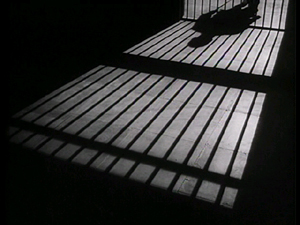
One of several arresting images from the Gestapo HQ sequence.
There's so much to talk about here, from the daring and effective decision to have the Germans speak in German while the Czechs speak English, to the weird sense of dissonance brought on by Walter Brennan pretending to be an intellectual European when you want him to be croaking at John Wayne, to the way that Alexander Granach's Gestapo officer comes off as a perverse, sadistic but compelling version of Hercule Poirot.
But I'd rather encourage you to watch the film yourself and come back and leave your thoughts in the comments. It really is an amazing, under-rated film that deserves further exposure.
This blog post is part of the For the Love of Film (Noir) Blog-A-Thon, which is raising money to restore the influential but obscure noir The Sound of Fury. If you are interested in donating to this important cause, click here.


Thursday, February 10, 2011
Okay, BADLANDS is a pretty awesome movie...
but why does everything I've ever heard about it focuses on the lyricism and ignores the dark humor pervading it? I don't see how you can hear Spacek's narration and not read into it some irony (on the behalf of the film, not of Spacek's character).
Also, it would make an interesting companion piece to the Coen Brothers' True Grit. Both feature female leads and narrators who are introduced into a world of violence starting with the murder of their father, then find themselves being dragged along by older men. And at the end, their efforts feel empty and leave them marked. The visual tone of the films is also similar, elegiac and beautiful while showing some really messed-up stuff happening.
Also, it would make an interesting companion piece to the Coen Brothers' True Grit. Both feature female leads and narrators who are introduced into a world of violence starting with the murder of their father, then find themselves being dragged along by older men. And at the end, their efforts feel empty and leave them marked. The visual tone of the films is also similar, elegiac and beautiful while showing some really messed-up stuff happening.
Monday, February 7, 2011
Coming soon to a blog near you...
I know I haven't been updating much lately, despite having a lot of awesome things happen and seeing a lot of awesome movies.
However, I have promised to participate in the brilliant and charming Self-Styled Siren's For the Love of Film Noir blog-a-thon (link to donate to the restoration of a great noir film here).
I'm choosing between one of two films. Haven't quite decided which to post. Hint: one involves three actors named Robert and anti-semitism, the other involves a Nazi anti-hero.
More content soon, I promise!
However, I have promised to participate in the brilliant and charming Self-Styled Siren's For the Love of Film Noir blog-a-thon (link to donate to the restoration of a great noir film here).
I'm choosing between one of two films. Haven't quite decided which to post. Hint: one involves three actors named Robert and anti-semitism, the other involves a Nazi anti-hero.
More content soon, I promise!
Monday, January 31, 2011
UNITED TRASH at The Silent Movie Theatre's NIGHT WITH UDO KIER
Cinefamily at Silent Movie Theatre's "Night with Udo Kier" was an embarassment of riches. The showing of the Kier-starring short film MRS. MEITLEMEIHR and two previously unscreened Guy Maddin shorts (part of a project to reconstruct over 200 lost silent films) were fascinating and a fitting tribute to the actor's comedic and avant-garde sides. And the Q and A session, in which Udo responded frankly and engagingly to moderator questions and audience questions, was also fascinating. While Kier's biography would be a fascinating thing to read, what hooked me the most was his comment that, the reason he thought he did such a good job playing bad guys and creeps was that, at heart, he was a nice guy.
And of course, Kier seemed to enjoy the night as much as we did. He remarked that this was the first time he'd ever seen a marquee lit up with his name and that he wanted to get a picture of it himself. I feel like what makes Kier so engaging as a performer and a person is that combination of professionalism and sheer enthusiasm he has somehow maintained over almost a half-century. Even when he's appearing in a Uwe Boll film, he's enthusiastic about being in the same film as Michael Madsen and Ben Kingsley. And it's great to see someone who still recognizes the sheer fun of getting to do a photo-shoot with Madonna or smell Pamela Anderson as his day job.
But I think what I'd really like to talk about is UNITED TRASH (a.k.a. THE SLIT, 1996), the feature-length film they showed. Directed by Christoph Schlingensief, starring Udo Kier and Kitten Natividad, this film really is something.
Thursday, January 20, 2011
Great moments in history, part 1...
Courtesy of Julia Lovell's hilarious and nuanced history, The Great Wall: China Against the World :
:
Let me add, that Ma Shun's superior basically caused the massacre of an entire Chinese army because he didn't want soldiers marching through his own property and then forced them to delay after a valiant rear-guard defense against a Mongol horde.... because he was afraid he had lost his luggage.
Truth is definitely stranger than fiction.


:After Wang [a eunuch tutor with great hold over the previous emperor]'s death in battle, officials took a terrible revenge on Ma Shun, one of Wang's surviving eunuch lieutenants at court. In an extraordinary scene, unprecedented and unrepeated in Chinese political history, a bloody fistfight broke out at an imperial audience when, unable to restrain his hatred of his eunuch rivals any longer, a censor rushed at Ma, wrestled him to the ground and bit him. Other officials immediately abandoned all sense of decorum and leapt into the scrum. Lacking in conventional arms, the struggle was brutishly drawn out with improvised bludgeons: officials eventually blinded and battered the eunuch to death with his own boots [Emphasis mine]. The nervous new emperor tried to escape the bloody fray by tiptoeing out of the audience chamber, until the new minister of war grabbed him back by his robe, forcing him to condone this spontaneous execution scene. (199)
Let me add, that Ma Shun's superior basically caused the massacre of an entire Chinese army because he didn't want soldiers marching through his own property and then forced them to delay after a valiant rear-guard defense against a Mongol horde.... because he was afraid he had lost his luggage.
Truth is definitely stranger than fiction.
Subscribe to:
Posts (Atom)