Pop culture says a lot about a country, and the pop culture that best gives someone an idea about the country's mindset is rarely the culture that people praise. It's usually not the Pulitzer Prize winners or the Oscar winners that we look back on as time capsules of what America was like. It's the Valley of the Dolls and Dirty Harry.
Whenever people (usually conservatives) attack academia, it's for writing papers on TV or comic books or music or movies with little Harold Bloom-approved value. What's the value, your ivory tower-hating good ol' regular American pundit might say, of writing about the semiotics of Law and Order or the post-capitalist structuralism of Justin Bieber?
And I know this might seem like a straw-man kind of thing, but then again, take Naomi Schaefer Riley. Please.
Anyway, already-dated digs at blogosphere dust-ups aside, my point is, what we say in our trashy and/or guilty pleasures and what, more importantly, the public enjoys in their trashy and/or guilty pleasures tells the observer a lot about the public values. It hints at what is in their hearts, instead of what they claim to think.
Looking at Law and Order, for example, what's important is not the mild liberalism of the writers and producers. What is important is that we have the picture of a justice system that is incredibly perceptive and hands-on. The detectives, flawed or cynical as they might be, have a dogged determination and usually lay their hands on a suspect within a matter of days, if not hours. The prosecutors and defense attorneys are usually well-trained, highly-capable individuals, who fight out their battles in front of a jury, and win and lose their cases on the basis of savvy detective work and a keen grasp of the law.
You don't see the large number of cases that remain unsolved, the large number of cases that are quickly plea-bargained out, cops who are petty or mediocre, overworked and underpaid lawyers who offload a lot of their day-to-day duties onto paralegals. Have you ever seen a paralegal show up on Law and Order, or Criminal Minds or CSI: Whatever?
But yet, even at our most cynical, whatever our political background, we think that this is our ideal. This is how the system is supposed to work!
In the last couple of months, two of my trashier pleasures have been Conan the Barbarian (mostly the comics, though I also watched the first film) and Golgo 13 (the anime movies and TV episodes and a little bit of the manga). And on their surface, there are definitely a lot of similarities between the two works, at the generic level.
Conan the Barbarian is a muscle-bound, hard-fighting, hard-living quasi-Nordic warrior in a vaguely pre-medieval, post-Roman Eurasia, who wanders from town to town looking for wenches, wine, and chances to make money as either a thief or a soldier. The women he captures or rescues usually fall in love with him, for at least a little while.
Golgo 13 (a.k.a. Duke Togo) is a muscular Japanese assassin who travels around the world, shooting targets in incredibly impossible situations for money. When he's not killing people, he's usually bedding women in very manly ways.*
Both are clearly male empowerment fantasies, built around the idea that men express their manliness by killing/fighting and having sex with women. The most manly specimens are those that are paid for killing/fighting.
You don't have to look very far for other examples of this empowerment fantasy across genre and form of media. Almost all the Arnold Schwarzenegger protagonists, the Punisher, Wolverine, the Continental Op, most gangsta rappers, and so forth.**
I don't think it's necessary, at this point, to even discuss the fact that women are usually passive characters and victims, with their roles limited to mothers or whores.
But there is a deeper co-relation between Conan and Golgo 13 than that. Historically, culturally, and morally, they share a deeper kinship.
Conan was created by Robert E. Howard between 1929-1930, and his adventures first appeared in the 1930s. After Howard's suicide in 1936, his adventures were kept in print and republished by the executors of his estate, on and off, for the next three decades. However, it was not until the late sixties and early seventies that the character's success flowered with the publication of the Lancer/Ace paperbacks and the start of Marvel Comic's highly successful run of Conan comic books and black-and-white magazines.
Furthermore, post-Howard, a large part of Conan's image as a character was shaped by a series of collaborators, artists and editors with either a loose affiliation with Howard or no connection with him at all. A "studio system" aesthetic evolved, where writers like L. Sprague de Camp, Lin Carter, Bjorn Nyberg and Roy Thomas, and artists like Boris Vallejo, Barry Windsor-Smith, and John Buscema, added significant portions to the Conan mythos or rewrote other non-Conan stories by Howard to become Conan stories. Roy Thomas, in a quest to create content for Marvel's comics and magazines, even appropriated and licensed the non-Conan works of other fantasy writers!***
Though there was mercenary element at work here, the creators intended to serve Conan (or at least their vision of Conan). This was no egotistical attempt by upstart crows to beautify themselves with another's feathers, as might characterize August Derleth's appropriation of H.P. Lovecraft's work.
Golgo 13 was created by Takao Saito in the late 1960s and was first published in 1969. Though Takao Saito was Golgo's creator, the art and writing duties of the series are generally handled by a studio under his supervision. Though Saito's role in the day-to-day operations of the studio are certainly open to speculation, his name is the only one that appears in the credits for the manga.
Furthermore, the live action movies and the anime movies and TV series are under the control of others, though they draw on the comics for inspiration.
What's important to emphasize here is that the late 1960s and early 1970s was the first time either of these characters could command mass appeal. Leaving aside the gore and gruesomeness of their adventures (with extreme violence becoming more mainstream thanks to film and the TV news), both characters possessed a sexual rapaciousness that was only starting to become acceptable toward the end of the 1960s.
However, at the same time, both characters occupy a space of protest against the hippie/protest movements of the time. Their sexual appetites might seem part of the "Summer of Love", but their attitudes towards women are not progressive or feminist. Both characters are satisfied with a market economy and have no qualms with positioning themselves as commodities. Insofar as they display a political consciousness, it could be characterized as conservative, though they are rather apolitical. And though neither is racist or nationalist, their adventures and interactions usually express chauvinism towards cultures than their own.
I will deal more with these characterizations of Conan and Golgo in my next post.
I also wish to say, as a disclaimer, that I am not trying to characterize the political convictions of the writers/artists/editors working on these characters. Roy Thomas, at the very least, strikes me as a relatively progressive writer from his other comic book work. The tenor of these characters' adventures, however, definitely are on the conservative end of the spectrum, and the generic conventions work against progressive or leftist influences.
Anyway, next time: what Golgo says about Japan and what Conan says about America. Yup, I'm aiming big!
*(For a more detailed history of Golgo 13 than I would ever be capable of writing, visit Joe McCulloch's detailed write-up of Golgo here, here and here.)
** However, from my point of view, these characters are not law enforcement and they are not government agents. James Bond might be the one exception. But all of these characters, though they might have a moral system, are not constrained by law or (usually) a chain of command. John McClane, for example, is very different from John Matrix (from Commando). While both kill bad guys, McClane is functioning as a protector of society. Matrix only cares about his daughter and enforcing his own sense of justice. McClane goes back to being a cop. Matrix rejects the idea of going back to be a soldier.
*** Norvell Page's Flame Winds, which was originally about Prester John in China, became a Conan adventure!
Showing posts with label low culture. Show all posts
Showing posts with label low culture. Show all posts
Friday, September 7, 2012

Sunday, June 17, 2012
On Selling My Comic Book Collection, Part 2
In my last post, which was way, way too long ago, I wrote some about the road that brought me to the selling of my comic book collection. Now I'll pick up with part 2...
When I first started entering my comics on Lonestar Comic's website, it was in part just curiousity. Were my comics actually worth anything? Or were they just random packages of paper, taking up space....
The answer is that they were worth something, but very few of them were worth anything much. A few of my G.I. Joe comics were worth between 50-100 dollars, as they came from late in the Marvel run and had not been collected. But most of the comics were worth maybe half or a quarter of what I paid for them, if I was lucky.
But I wasn't looking to get what I'd paid for them. I was just looking to free up space, to remove clutter, to have one less box to move the next time I changed apartments. And if I could pick up spending money while I did it, so much the better.
So I started the purge. First to go were a large chunk of the comics I had purchased since going off to college. I sold off a ton of Nu/New Marvel and countless DC reboots and "new" takes on iconic properties. I can't say I really felt anything at them going. I'd enjoyed many of them on the first read-through, but very few had ever earned a re-read or even a second thought.
Then, on a visit home, I started culling the old collection: the crappy to mediocre '90s comics that I had cut my teeth on: Spider-Man's clones, Wolverine without a nose, GI Joes fighting Transformers... I felt a small nostalgic twinge (and I held on to the first few comics I had purchased), but I never read them. They gave me a warm fuzzy feeling when I thought of them, but they just took up space in my parents' house and I didn't really enjoy the actual things. Goodbye to those.
At this point, I started cutting deeper and deeper. I said goodbye to reprints of stuff that had been reprinted in better editions and poor condition Silver Age comics that I'd purchased just to feel like I was a serious collector. These I felt more uncomfortable with letting go, but whatever the problems of the comic book market today, it's relatively easy to get quality reprints of everything from Ditko and Kirby monster comics to Flex Mentallo (!).
I'm not going to claim that there weren't moments of sadness as I did this. But this wasn't like the little kid in Puff the Magic Dragon saying goodbye to his imaginary friend. These were things that brought me very little joy, except in the abstract or in my memories. Other people wanted them and other people might enjoy them. And in return, I would get money to spend on creating new memories or received trade credit I used to get comics I had never read.
And as I went through my collection, I rediscovered the comics that I did enjoy. And even as I said goodbye to a large portion of my collection, I remembered the joy they had given me at the time I bought them.
Selling off my comics, strangely enough, made me more interested in reading comics than I had been in ages.
When I first started entering my comics on Lonestar Comic's website, it was in part just curiousity. Were my comics actually worth anything? Or were they just random packages of paper, taking up space....
The answer is that they were worth something, but very few of them were worth anything much. A few of my G.I. Joe comics were worth between 50-100 dollars, as they came from late in the Marvel run and had not been collected. But most of the comics were worth maybe half or a quarter of what I paid for them, if I was lucky.
But I wasn't looking to get what I'd paid for them. I was just looking to free up space, to remove clutter, to have one less box to move the next time I changed apartments. And if I could pick up spending money while I did it, so much the better.
So I started the purge. First to go were a large chunk of the comics I had purchased since going off to college. I sold off a ton of Nu/New Marvel and countless DC reboots and "new" takes on iconic properties. I can't say I really felt anything at them going. I'd enjoyed many of them on the first read-through, but very few had ever earned a re-read or even a second thought.
Then, on a visit home, I started culling the old collection: the crappy to mediocre '90s comics that I had cut my teeth on: Spider-Man's clones, Wolverine without a nose, GI Joes fighting Transformers... I felt a small nostalgic twinge (and I held on to the first few comics I had purchased), but I never read them. They gave me a warm fuzzy feeling when I thought of them, but they just took up space in my parents' house and I didn't really enjoy the actual things. Goodbye to those.
At this point, I started cutting deeper and deeper. I said goodbye to reprints of stuff that had been reprinted in better editions and poor condition Silver Age comics that I'd purchased just to feel like I was a serious collector. These I felt more uncomfortable with letting go, but whatever the problems of the comic book market today, it's relatively easy to get quality reprints of everything from Ditko and Kirby monster comics to Flex Mentallo (!).
I'm not going to claim that there weren't moments of sadness as I did this. But this wasn't like the little kid in Puff the Magic Dragon saying goodbye to his imaginary friend. These were things that brought me very little joy, except in the abstract or in my memories. Other people wanted them and other people might enjoy them. And in return, I would get money to spend on creating new memories or received trade credit I used to get comics I had never read.
And as I went through my collection, I rediscovered the comics that I did enjoy. And even as I said goodbye to a large portion of my collection, I remembered the joy they had given me at the time I bought them.
Selling off my comics, strangely enough, made me more interested in reading comics than I had been in ages.
Saturday, August 13, 2011
Religion in the Marvel and DC universes
So, the wonderful and talented Wizera has decided to enter the internet blogosphere, and her post about modern-day depictions of the Olympian underworld as a Hell-equivalent reminded me of how weird the Marvel and DC universes are, where religion is concerned.
For example, in the Marvel universe, you've got the Norse and Greek pantheons, who have their own afterlives (Hel running Valhalla, Pluto running the Olympian underworld) and own special cosmology. At the same time, there is also a group called the Eternals who are clearly the basis of many of the Marvel universe's legends (and, by extension, ours) who were created by a group of alien intelligences called the Celestials who exist on a cosmological plane with a lot of other vague cosmically powered beings such as the In-Betweener, the Beyonder, the Watcher, and Galactus.*

On top of that, there are various supernatural planes, deities and forces such as Nightmare, Dormamu, Cyttorak (which is a dimension as well as a god, I believe), and the Darkforce/Living Light duality. These have frequently been shown as capable of interacting with both the mythological gods and the cosmic forces.
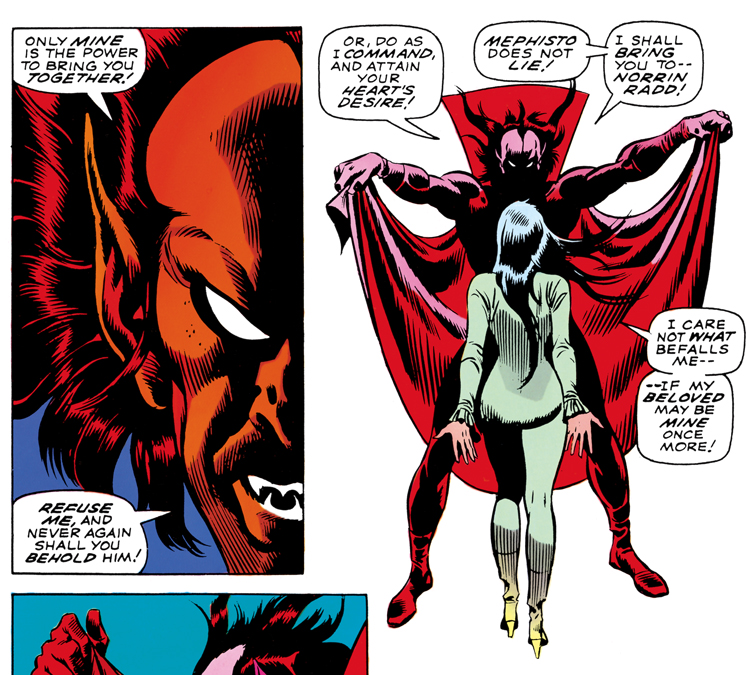
And there is still a Judeo-Christian cosmology and afterlife, since, for example, Doctor Doom's mother is a gypsy trapped in Hell who he frequently tried to rescue**. These afterlives might co-exist/be the same aspect of the occasional place-holder concepts meant to avoid literally saying the words Hell and/or God, etc in a mainstream publication aimed at kids. So, therefore, you have characters like Mephisto (who is clearly the Devil) at the same time as having a character whose name is Son of Satan who is the son of the actual (Judeo-Christian) Satan.***

Now, this kind of confusion is not intentional. A lot of the problem goes back to the fact, originally, that a lot of these comics were written in an age where Judeo-Christianity was assumed to be practiced by most people in America WHILE, at the same time, it was considered offensive or improper for low culture especially to name or reference religion. And more importantly, a lot of these characters were supposed to be aimed at kids or teenagers, and very few people want a young person's religious education to be from a SILVER SURFER comic (though whether their normal religious education is actually any better thought out or put-together than a given SILVER SURFER comic is a question rarely asked.)
But around the end of the 1960s/beginning of the 1970s, some writers and artists started wanting to explore the morality of comics with some level of complexity. At the same time, the Comics Code Authority started lifting some of the bans they'd had on supernatural characters, which led creators to stretch their boundaries some more.
At the same time, however, comic fans had matured. They'd grown up with characters who got their powers from Heck or fought the powers of Hades. And while they wanted to see their characters get more complex, the morality of the characters get more nuanced and adult, they also believed in the sanctity of the stories that came before.
So, while still toeing a Judeo-Christian line (as that's the ethic that pervades Western superhero comics, so that even Supergirl, after being erased by a cosmic meta-fictional entity, could show up and tell a ghost created by a pseudo-Hindu god what the meaning of Christmas was...)

Both DC and Marvel have quietly become polytheistic universes, without quite admitting or understanding it. It's like how pagan gods got co-opted by early Catholics, transformed into non-canonical saints and martyrs, or how even real saints took the place of sprites/demons/fairies/household gods in the minds of the medieval peasantry.
But hey, as a result, we can have comics where a magician gets almost killed by Satan's bastard son and then learns the secrets of the Druids from some Tibetan lamas. So there's that.
* OTOH, Galactus was supposed to be from some sort of higher plane of existence, which was destroyed by entropy, and was transformed by the shift in planes. So he actually does have a start and end date, being co-terminal with the Marvel universe instead of preceding it. And if any of you have ever read anything of Medieval philosophy and theology, you know why that's a big deal.
** For those of you new to this aspect of Dr. Doom, his mother ending up in hell had more to do with an actual deal with the devil rather than some sort of high-handed "how dare you not go to the right church" kind of thing.
*** Yes. He was a superhero in spandex and a cape, who fought evil with powers he got from being the son of the Devil. Which has to be the worst superhero origin story ever.
For example, in the Marvel universe, you've got the Norse and Greek pantheons, who have their own afterlives (Hel running Valhalla, Pluto running the Olympian underworld) and own special cosmology. At the same time, there is also a group called the Eternals who are clearly the basis of many of the Marvel universe's legends (and, by extension, ours) who were created by a group of alien intelligences called the Celestials who exist on a cosmological plane with a lot of other vague cosmically powered beings such as the In-Betweener, the Beyonder, the Watcher, and Galactus.*
See, he's a Norse demi-god fighting the forces of Hell with a machine gun.
Makes perfect sense, right?
And there is still a Judeo-Christian cosmology and afterlife, since, for example, Doctor Doom's mother is a gypsy trapped in Hell who he frequently tried to rescue**. These afterlives might co-exist/be the same aspect of the occasional place-holder concepts meant to avoid literally saying the words Hell and/or God, etc in a mainstream publication aimed at kids. So, therefore, you have characters like Mephisto (who is clearly the Devil) at the same time as having a character whose name is Son of Satan who is the son of the actual (Judeo-Christian) Satan.***
Bet you didn't know you could defeat the Devil if you just combined science & sorcery!
Now, this kind of confusion is not intentional. A lot of the problem goes back to the fact, originally, that a lot of these comics were written in an age where Judeo-Christianity was assumed to be practiced by most people in America WHILE, at the same time, it was considered offensive or improper for low culture especially to name or reference religion. And more importantly, a lot of these characters were supposed to be aimed at kids or teenagers, and very few people want a young person's religious education to be from a SILVER SURFER comic (though whether their normal religious education is actually any better thought out or put-together than a given SILVER SURFER comic is a question rarely asked.)
See, you can trust him because he's definitely not the Devil. Definitely not.
But around the end of the 1960s/beginning of the 1970s, some writers and artists started wanting to explore the morality of comics with some level of complexity. At the same time, the Comics Code Authority started lifting some of the bans they'd had on supernatural characters, which led creators to stretch their boundaries some more.
At the same time, however, comic fans had matured. They'd grown up with characters who got their powers from Heck or fought the powers of Hades. And while they wanted to see their characters get more complex, the morality of the characters get more nuanced and adult, they also believed in the sanctity of the stories that came before.
So, while still toeing a Judeo-Christian line (as that's the ethic that pervades Western superhero comics, so that even Supergirl, after being erased by a cosmic meta-fictional entity, could show up and tell a ghost created by a pseudo-Hindu god what the meaning of Christmas was...)

They really couldn't have timed this for Makar Sankrati instead?
Both DC and Marvel have quietly become polytheistic universes, without quite admitting or understanding it. It's like how pagan gods got co-opted by early Catholics, transformed into non-canonical saints and martyrs, or how even real saints took the place of sprites/demons/fairies/household gods in the minds of the medieval peasantry.
But hey, as a result, we can have comics where a magician gets almost killed by Satan's bastard son and then learns the secrets of the Druids from some Tibetan lamas. So there's that.
* OTOH, Galactus was supposed to be from some sort of higher plane of existence, which was destroyed by entropy, and was transformed by the shift in planes. So he actually does have a start and end date, being co-terminal with the Marvel universe instead of preceding it. And if any of you have ever read anything of Medieval philosophy and theology, you know why that's a big deal.
** For those of you new to this aspect of Dr. Doom, his mother ending up in hell had more to do with an actual deal with the devil rather than some sort of high-handed "how dare you not go to the right church" kind of thing.
*** Yes. He was a superhero in spandex and a cape, who fought evil with powers he got from being the son of the Devil. Which has to be the worst superhero origin story ever.
Subscribe to:
Posts (Atom)