So, once again, I am contributing to a Deadshirt retrospective, this time about Batman, in honor of
Coldstone Creamery, Turkish Airlines & Warner Brothers Presents Batman vs. Superman: Dawn of Franchises.
My choice was The Dark Knight Rises. And it's still a flawed movie, but some of those flaws now seem kind of charming? Check it out here!
Showing posts with label comic books. Show all posts
Showing posts with label comic books. Show all posts
Tuesday, March 15, 2016

Thursday, July 11, 2013
Thought about Steve Ditko
It's been a while between posts, but life has been interfering. To tide you over, here's something I wrote about Steve Ditko's latest work from Robin Snyder's publishing imprint. They are Kickstarting a reprint of another one of Ditko's later works right here. My thoughts, inspired by reading his self-published SEVENTEEN:
There’s something great about seeing a master at work, who is comfortable and confident enough with his style to pare the work down to the bare essentials. Very few creators get there (or have the opportunity to get there), so I’m glad readers get a chance to witness Steve Ditko at this stage. It reminds me of John Ford in his late period, how he could make a film like THE MAN WHO SHOT LIBERTY VALANCE where every shot, every gesture, every word is essential. I feel that is where Steve Ditko is at. Every pencil stroke, every word, every image is essential.
Thursday, October 11, 2012
Primer on BUILDING STORIES & Chris Ware
Chris Ware's BUILDING STORIES is out, which means its time for media coverage to begin. Since a lot of media outlets generally don't have the time or knowledge to do in-depth research into "comic books", "graphic novels" or "those things kids like". So, for everyone out there just getting into Chris Ware, he's a simple guide to Chris Ware and his work.
Q: Who is Chris Ware?
A: Most people believe that Chris Ware is a sensitive writer-artist based out of the Chicago area. What most people don't realize is that this is a lie!
Chris Ware is actually an alias for Rob Liefeld, the controversial artist who broke into comics in the '80s with HAWK & DOVE and NEW MUTANTS. The "Chris Ware" persona was hatched over a drunken bull session with Gary Groth of The Comics Journal at the San Diego Comicon in 1995. Groth said that Liefeld would never create a comic book he liked. Liefeld said if he did, Groth would have to give every book he did under the pseudonym at least a week's worth of coverage. Groth lost the bet. And "Chris Ware" was born.
Industry folks also claim that "Dan Clowes" is another alias for Rob Liefeld. That is stupid. "Dan Clowes" is the name of the studio that Marc Silvestri and Jim Balent have founded.
Q: What is BUILDING STORIES about?
A: As always, where art is concerned, it depends on how you interpret the contents. Some people say that it is the story of a lonely woman, trying to connect with the world around her. Others say that it is a narrative about post-Modern America's disconnect from itself. All I can say is, it finally resolves what Jimmy Corrigan, the Smartest Boy on Earth, was doing during INFINITE CRISIS.
Q: I heard that Ware did something weird with the packaging. Is that true?
A: Yes. Chris Ware had trees chopped up and the resulting wood transformed into wood pulp. He then had giant machines transform that pulp into a regular shape, upon which it would be easy to imprint different colored-inks. Those flimsy pieces of pulp were then bound between slightly less flimsy pieces of pulp, put into containers, and shipped to different retail outlets and warehouses where they could be obtained by consumers. All in all, a very previous and artistic way to disseminate art in our modern age.
Also, there are slight variations in the way those piece of pulp are organized and combined, from one printing to another. This has never happened before in the history of comic books.
Q: Does this mean comics aren't for kids anymore? Can I add "Biff! Bang! Pow!" to the headline?
A: Comics have not been printed for kids since 1970. They are mostly consumed by rocks, sentient bacteria, and the Omni-Being from the Dark Galaxy of Quadrant 5.
But go ahead with the "Biff!" "Bang!" "Pow!" to your headline. No one has ever thought of that joke before.
Q: Have you even read BUILDING STORIES yet?
A: That's ridiculous. If I read BUILDING STORIES, I'd have to pick an order to read it in, and I might pick the wrong order!
Also, I hear Joss Whedon plans to make a movie version of it.
Q: Who is Chris Ware?
A: Most people believe that Chris Ware is a sensitive writer-artist based out of the Chicago area. What most people don't realize is that this is a lie!
Chris Ware is actually an alias for Rob Liefeld, the controversial artist who broke into comics in the '80s with HAWK & DOVE and NEW MUTANTS. The "Chris Ware" persona was hatched over a drunken bull session with Gary Groth of The Comics Journal at the San Diego Comicon in 1995. Groth said that Liefeld would never create a comic book he liked. Liefeld said if he did, Groth would have to give every book he did under the pseudonym at least a week's worth of coverage. Groth lost the bet. And "Chris Ware" was born.
Industry folks also claim that "Dan Clowes" is another alias for Rob Liefeld. That is stupid. "Dan Clowes" is the name of the studio that Marc Silvestri and Jim Balent have founded.
Q: What is BUILDING STORIES about?
A: As always, where art is concerned, it depends on how you interpret the contents. Some people say that it is the story of a lonely woman, trying to connect with the world around her. Others say that it is a narrative about post-Modern America's disconnect from itself. All I can say is, it finally resolves what Jimmy Corrigan, the Smartest Boy on Earth, was doing during INFINITE CRISIS.
Q: I heard that Ware did something weird with the packaging. Is that true?
A: Yes. Chris Ware had trees chopped up and the resulting wood transformed into wood pulp. He then had giant machines transform that pulp into a regular shape, upon which it would be easy to imprint different colored-inks. Those flimsy pieces of pulp were then bound between slightly less flimsy pieces of pulp, put into containers, and shipped to different retail outlets and warehouses where they could be obtained by consumers. All in all, a very previous and artistic way to disseminate art in our modern age.
Also, there are slight variations in the way those piece of pulp are organized and combined, from one printing to another. This has never happened before in the history of comic books.
Q: Does this mean comics aren't for kids anymore? Can I add "Biff! Bang! Pow!" to the headline?
A: Comics have not been printed for kids since 1970. They are mostly consumed by rocks, sentient bacteria, and the Omni-Being from the Dark Galaxy of Quadrant 5.
But go ahead with the "Biff!" "Bang!" "Pow!" to your headline. No one has ever thought of that joke before.
Q: Have you even read BUILDING STORIES yet?
A: That's ridiculous. If I read BUILDING STORIES, I'd have to pick an order to read it in, and I might pick the wrong order!
Also, I hear Joss Whedon plans to make a movie version of it.
Thursday, September 27, 2012


Friday, September 7, 2012
The Shadow of the Gunman and the Swordsman: Golgo 13 and Conan the Barbarian
Pop culture says a lot about a country, and the pop culture that best gives someone an idea about the country's mindset is rarely the culture that people praise. It's usually not the Pulitzer Prize winners or the Oscar winners that we look back on as time capsules of what America was like. It's the Valley of the Dolls and Dirty Harry.
Whenever people (usually conservatives) attack academia, it's for writing papers on TV or comic books or music or movies with little Harold Bloom-approved value. What's the value, your ivory tower-hating good ol' regular American pundit might say, of writing about the semiotics of Law and Order or the post-capitalist structuralism of Justin Bieber?
And I know this might seem like a straw-man kind of thing, but then again, take Naomi Schaefer Riley. Please.
Anyway, already-dated digs at blogosphere dust-ups aside, my point is, what we say in our trashy and/or guilty pleasures and what, more importantly, the public enjoys in their trashy and/or guilty pleasures tells the observer a lot about the public values. It hints at what is in their hearts, instead of what they claim to think.
Looking at Law and Order, for example, what's important is not the mild liberalism of the writers and producers. What is important is that we have the picture of a justice system that is incredibly perceptive and hands-on. The detectives, flawed or cynical as they might be, have a dogged determination and usually lay their hands on a suspect within a matter of days, if not hours. The prosecutors and defense attorneys are usually well-trained, highly-capable individuals, who fight out their battles in front of a jury, and win and lose their cases on the basis of savvy detective work and a keen grasp of the law.
You don't see the large number of cases that remain unsolved, the large number of cases that are quickly plea-bargained out, cops who are petty or mediocre, overworked and underpaid lawyers who offload a lot of their day-to-day duties onto paralegals. Have you ever seen a paralegal show up on Law and Order, or Criminal Minds or CSI: Whatever?
But yet, even at our most cynical, whatever our political background, we think that this is our ideal. This is how the system is supposed to work!
In the last couple of months, two of my trashier pleasures have been Conan the Barbarian (mostly the comics, though I also watched the first film) and Golgo 13 (the anime movies and TV episodes and a little bit of the manga). And on their surface, there are definitely a lot of similarities between the two works, at the generic level.
Conan the Barbarian is a muscle-bound, hard-fighting, hard-living quasi-Nordic warrior in a vaguely pre-medieval, post-Roman Eurasia, who wanders from town to town looking for wenches, wine, and chances to make money as either a thief or a soldier. The women he captures or rescues usually fall in love with him, for at least a little while.
Golgo 13 (a.k.a. Duke Togo) is a muscular Japanese assassin who travels around the world, shooting targets in incredibly impossible situations for money. When he's not killing people, he's usually bedding women in very manly ways.*
Both are clearly male empowerment fantasies, built around the idea that men express their manliness by killing/fighting and having sex with women. The most manly specimens are those that are paid for killing/fighting.
You don't have to look very far for other examples of this empowerment fantasy across genre and form of media. Almost all the Arnold Schwarzenegger protagonists, the Punisher, Wolverine, the Continental Op, most gangsta rappers, and so forth.**
I don't think it's necessary, at this point, to even discuss the fact that women are usually passive characters and victims, with their roles limited to mothers or whores.
But there is a deeper co-relation between Conan and Golgo 13 than that. Historically, culturally, and morally, they share a deeper kinship.
Conan was created by Robert E. Howard between 1929-1930, and his adventures first appeared in the 1930s. After Howard's suicide in 1936, his adventures were kept in print and republished by the executors of his estate, on and off, for the next three decades. However, it was not until the late sixties and early seventies that the character's success flowered with the publication of the Lancer/Ace paperbacks and the start of Marvel Comic's highly successful run of Conan comic books and black-and-white magazines.
Furthermore, post-Howard, a large part of Conan's image as a character was shaped by a series of collaborators, artists and editors with either a loose affiliation with Howard or no connection with him at all. A "studio system" aesthetic evolved, where writers like L. Sprague de Camp, Lin Carter, Bjorn Nyberg and Roy Thomas, and artists like Boris Vallejo, Barry Windsor-Smith, and John Buscema, added significant portions to the Conan mythos or rewrote other non-Conan stories by Howard to become Conan stories. Roy Thomas, in a quest to create content for Marvel's comics and magazines, even appropriated and licensed the non-Conan works of other fantasy writers!***
Though there was mercenary element at work here, the creators intended to serve Conan (or at least their vision of Conan). This was no egotistical attempt by upstart crows to beautify themselves with another's feathers, as might characterize August Derleth's appropriation of H.P. Lovecraft's work.
Golgo 13 was created by Takao Saito in the late 1960s and was first published in 1969. Though Takao Saito was Golgo's creator, the art and writing duties of the series are generally handled by a studio under his supervision. Though Saito's role in the day-to-day operations of the studio are certainly open to speculation, his name is the only one that appears in the credits for the manga.
Furthermore, the live action movies and the anime movies and TV series are under the control of others, though they draw on the comics for inspiration.
What's important to emphasize here is that the late 1960s and early 1970s was the first time either of these characters could command mass appeal. Leaving aside the gore and gruesomeness of their adventures (with extreme violence becoming more mainstream thanks to film and the TV news), both characters possessed a sexual rapaciousness that was only starting to become acceptable toward the end of the 1960s.
However, at the same time, both characters occupy a space of protest against the hippie/protest movements of the time. Their sexual appetites might seem part of the "Summer of Love", but their attitudes towards women are not progressive or feminist. Both characters are satisfied with a market economy and have no qualms with positioning themselves as commodities. Insofar as they display a political consciousness, it could be characterized as conservative, though they are rather apolitical. And though neither is racist or nationalist, their adventures and interactions usually express chauvinism towards cultures than their own.
I will deal more with these characterizations of Conan and Golgo in my next post.
I also wish to say, as a disclaimer, that I am not trying to characterize the political convictions of the writers/artists/editors working on these characters. Roy Thomas, at the very least, strikes me as a relatively progressive writer from his other comic book work. The tenor of these characters' adventures, however, definitely are on the conservative end of the spectrum, and the generic conventions work against progressive or leftist influences.
Anyway, next time: what Golgo says about Japan and what Conan says about America. Yup, I'm aiming big!
*(For a more detailed history of Golgo 13 than I would ever be capable of writing, visit Joe McCulloch's detailed write-up of Golgo here, here and here.)
** However, from my point of view, these characters are not law enforcement and they are not government agents. James Bond might be the one exception. But all of these characters, though they might have a moral system, are not constrained by law or (usually) a chain of command. John McClane, for example, is very different from John Matrix (from Commando). While both kill bad guys, McClane is functioning as a protector of society. Matrix only cares about his daughter and enforcing his own sense of justice. McClane goes back to being a cop. Matrix rejects the idea of going back to be a soldier.
*** Norvell Page's Flame Winds, which was originally about Prester John in China, became a Conan adventure!
Whenever people (usually conservatives) attack academia, it's for writing papers on TV or comic books or music or movies with little Harold Bloom-approved value. What's the value, your ivory tower-hating good ol' regular American pundit might say, of writing about the semiotics of Law and Order or the post-capitalist structuralism of Justin Bieber?
And I know this might seem like a straw-man kind of thing, but then again, take Naomi Schaefer Riley. Please.
Anyway, already-dated digs at blogosphere dust-ups aside, my point is, what we say in our trashy and/or guilty pleasures and what, more importantly, the public enjoys in their trashy and/or guilty pleasures tells the observer a lot about the public values. It hints at what is in their hearts, instead of what they claim to think.
Looking at Law and Order, for example, what's important is not the mild liberalism of the writers and producers. What is important is that we have the picture of a justice system that is incredibly perceptive and hands-on. The detectives, flawed or cynical as they might be, have a dogged determination and usually lay their hands on a suspect within a matter of days, if not hours. The prosecutors and defense attorneys are usually well-trained, highly-capable individuals, who fight out their battles in front of a jury, and win and lose their cases on the basis of savvy detective work and a keen grasp of the law.
You don't see the large number of cases that remain unsolved, the large number of cases that are quickly plea-bargained out, cops who are petty or mediocre, overworked and underpaid lawyers who offload a lot of their day-to-day duties onto paralegals. Have you ever seen a paralegal show up on Law and Order, or Criminal Minds or CSI: Whatever?
But yet, even at our most cynical, whatever our political background, we think that this is our ideal. This is how the system is supposed to work!
In the last couple of months, two of my trashier pleasures have been Conan the Barbarian (mostly the comics, though I also watched the first film) and Golgo 13 (the anime movies and TV episodes and a little bit of the manga). And on their surface, there are definitely a lot of similarities between the two works, at the generic level.
Conan the Barbarian is a muscle-bound, hard-fighting, hard-living quasi-Nordic warrior in a vaguely pre-medieval, post-Roman Eurasia, who wanders from town to town looking for wenches, wine, and chances to make money as either a thief or a soldier. The women he captures or rescues usually fall in love with him, for at least a little while.
Golgo 13 (a.k.a. Duke Togo) is a muscular Japanese assassin who travels around the world, shooting targets in incredibly impossible situations for money. When he's not killing people, he's usually bedding women in very manly ways.*
Both are clearly male empowerment fantasies, built around the idea that men express their manliness by killing/fighting and having sex with women. The most manly specimens are those that are paid for killing/fighting.
You don't have to look very far for other examples of this empowerment fantasy across genre and form of media. Almost all the Arnold Schwarzenegger protagonists, the Punisher, Wolverine, the Continental Op, most gangsta rappers, and so forth.**
I don't think it's necessary, at this point, to even discuss the fact that women are usually passive characters and victims, with their roles limited to mothers or whores.
But there is a deeper co-relation between Conan and Golgo 13 than that. Historically, culturally, and morally, they share a deeper kinship.
Conan was created by Robert E. Howard between 1929-1930, and his adventures first appeared in the 1930s. After Howard's suicide in 1936, his adventures were kept in print and republished by the executors of his estate, on and off, for the next three decades. However, it was not until the late sixties and early seventies that the character's success flowered with the publication of the Lancer/Ace paperbacks and the start of Marvel Comic's highly successful run of Conan comic books and black-and-white magazines.
Furthermore, post-Howard, a large part of Conan's image as a character was shaped by a series of collaborators, artists and editors with either a loose affiliation with Howard or no connection with him at all. A "studio system" aesthetic evolved, where writers like L. Sprague de Camp, Lin Carter, Bjorn Nyberg and Roy Thomas, and artists like Boris Vallejo, Barry Windsor-Smith, and John Buscema, added significant portions to the Conan mythos or rewrote other non-Conan stories by Howard to become Conan stories. Roy Thomas, in a quest to create content for Marvel's comics and magazines, even appropriated and licensed the non-Conan works of other fantasy writers!***
Though there was mercenary element at work here, the creators intended to serve Conan (or at least their vision of Conan). This was no egotistical attempt by upstart crows to beautify themselves with another's feathers, as might characterize August Derleth's appropriation of H.P. Lovecraft's work.
Golgo 13 was created by Takao Saito in the late 1960s and was first published in 1969. Though Takao Saito was Golgo's creator, the art and writing duties of the series are generally handled by a studio under his supervision. Though Saito's role in the day-to-day operations of the studio are certainly open to speculation, his name is the only one that appears in the credits for the manga.
Furthermore, the live action movies and the anime movies and TV series are under the control of others, though they draw on the comics for inspiration.
What's important to emphasize here is that the late 1960s and early 1970s was the first time either of these characters could command mass appeal. Leaving aside the gore and gruesomeness of their adventures (with extreme violence becoming more mainstream thanks to film and the TV news), both characters possessed a sexual rapaciousness that was only starting to become acceptable toward the end of the 1960s.
However, at the same time, both characters occupy a space of protest against the hippie/protest movements of the time. Their sexual appetites might seem part of the "Summer of Love", but their attitudes towards women are not progressive or feminist. Both characters are satisfied with a market economy and have no qualms with positioning themselves as commodities. Insofar as they display a political consciousness, it could be characterized as conservative, though they are rather apolitical. And though neither is racist or nationalist, their adventures and interactions usually express chauvinism towards cultures than their own.
I will deal more with these characterizations of Conan and Golgo in my next post.
I also wish to say, as a disclaimer, that I am not trying to characterize the political convictions of the writers/artists/editors working on these characters. Roy Thomas, at the very least, strikes me as a relatively progressive writer from his other comic book work. The tenor of these characters' adventures, however, definitely are on the conservative end of the spectrum, and the generic conventions work against progressive or leftist influences.
Anyway, next time: what Golgo says about Japan and what Conan says about America. Yup, I'm aiming big!
*(For a more detailed history of Golgo 13 than I would ever be capable of writing, visit Joe McCulloch's detailed write-up of Golgo here, here and here.)
** However, from my point of view, these characters are not law enforcement and they are not government agents. James Bond might be the one exception. But all of these characters, though they might have a moral system, are not constrained by law or (usually) a chain of command. John McClane, for example, is very different from John Matrix (from Commando). While both kill bad guys, McClane is functioning as a protector of society. Matrix only cares about his daughter and enforcing his own sense of justice. McClane goes back to being a cop. Matrix rejects the idea of going back to be a soldier.
*** Norvell Page's Flame Winds, which was originally about Prester John in China, became a Conan adventure!
Sunday, June 17, 2012
On Selling My Comic Book Collection, Part 2
In my last post, which was way, way too long ago, I wrote some about the road that brought me to the selling of my comic book collection. Now I'll pick up with part 2...
When I first started entering my comics on Lonestar Comic's website, it was in part just curiousity. Were my comics actually worth anything? Or were they just random packages of paper, taking up space....
The answer is that they were worth something, but very few of them were worth anything much. A few of my G.I. Joe comics were worth between 50-100 dollars, as they came from late in the Marvel run and had not been collected. But most of the comics were worth maybe half or a quarter of what I paid for them, if I was lucky.
But I wasn't looking to get what I'd paid for them. I was just looking to free up space, to remove clutter, to have one less box to move the next time I changed apartments. And if I could pick up spending money while I did it, so much the better.
So I started the purge. First to go were a large chunk of the comics I had purchased since going off to college. I sold off a ton of Nu/New Marvel and countless DC reboots and "new" takes on iconic properties. I can't say I really felt anything at them going. I'd enjoyed many of them on the first read-through, but very few had ever earned a re-read or even a second thought.
Then, on a visit home, I started culling the old collection: the crappy to mediocre '90s comics that I had cut my teeth on: Spider-Man's clones, Wolverine without a nose, GI Joes fighting Transformers... I felt a small nostalgic twinge (and I held on to the first few comics I had purchased), but I never read them. They gave me a warm fuzzy feeling when I thought of them, but they just took up space in my parents' house and I didn't really enjoy the actual things. Goodbye to those.
At this point, I started cutting deeper and deeper. I said goodbye to reprints of stuff that had been reprinted in better editions and poor condition Silver Age comics that I'd purchased just to feel like I was a serious collector. These I felt more uncomfortable with letting go, but whatever the problems of the comic book market today, it's relatively easy to get quality reprints of everything from Ditko and Kirby monster comics to Flex Mentallo (!).
I'm not going to claim that there weren't moments of sadness as I did this. But this wasn't like the little kid in Puff the Magic Dragon saying goodbye to his imaginary friend. These were things that brought me very little joy, except in the abstract or in my memories. Other people wanted them and other people might enjoy them. And in return, I would get money to spend on creating new memories or received trade credit I used to get comics I had never read.
And as I went through my collection, I rediscovered the comics that I did enjoy. And even as I said goodbye to a large portion of my collection, I remembered the joy they had given me at the time I bought them.
Selling off my comics, strangely enough, made me more interested in reading comics than I had been in ages.
When I first started entering my comics on Lonestar Comic's website, it was in part just curiousity. Were my comics actually worth anything? Or were they just random packages of paper, taking up space....
The answer is that they were worth something, but very few of them were worth anything much. A few of my G.I. Joe comics were worth between 50-100 dollars, as they came from late in the Marvel run and had not been collected. But most of the comics were worth maybe half or a quarter of what I paid for them, if I was lucky.
But I wasn't looking to get what I'd paid for them. I was just looking to free up space, to remove clutter, to have one less box to move the next time I changed apartments. And if I could pick up spending money while I did it, so much the better.
So I started the purge. First to go were a large chunk of the comics I had purchased since going off to college. I sold off a ton of Nu/New Marvel and countless DC reboots and "new" takes on iconic properties. I can't say I really felt anything at them going. I'd enjoyed many of them on the first read-through, but very few had ever earned a re-read or even a second thought.
Then, on a visit home, I started culling the old collection: the crappy to mediocre '90s comics that I had cut my teeth on: Spider-Man's clones, Wolverine without a nose, GI Joes fighting Transformers... I felt a small nostalgic twinge (and I held on to the first few comics I had purchased), but I never read them. They gave me a warm fuzzy feeling when I thought of them, but they just took up space in my parents' house and I didn't really enjoy the actual things. Goodbye to those.
At this point, I started cutting deeper and deeper. I said goodbye to reprints of stuff that had been reprinted in better editions and poor condition Silver Age comics that I'd purchased just to feel like I was a serious collector. These I felt more uncomfortable with letting go, but whatever the problems of the comic book market today, it's relatively easy to get quality reprints of everything from Ditko and Kirby monster comics to Flex Mentallo (!).
I'm not going to claim that there weren't moments of sadness as I did this. But this wasn't like the little kid in Puff the Magic Dragon saying goodbye to his imaginary friend. These were things that brought me very little joy, except in the abstract or in my memories. Other people wanted them and other people might enjoy them. And in return, I would get money to spend on creating new memories or received trade credit I used to get comics I had never read.
And as I went through my collection, I rediscovered the comics that I did enjoy. And even as I said goodbye to a large portion of my collection, I remembered the joy they had given me at the time I bought them.
Selling off my comics, strangely enough, made me more interested in reading comics than I had been in ages.
Monday, April 16, 2012
On selling off my comic book collection...
So, about a year, year and a half ago, I decided to start selling off my comic book collection.
I've been collecting comic books since I was probably about 5, starting with G.I. Joe, moving on to Spider-Man and Wolverine, then finally onto the Silver Age stuff and collecting specific artists and writers (Morrison, Steranko, Kirby, Moore, Ellis, etc.). I kept buying regularly through college and, while I lived in Chicago, I kept a pull-list at Comix Revolution, then Graham Crackers (both great stores, in their own ways).
By the time I moved to Los Angeles, I had about three long boxes and 5 short boxes of comics with me, and another 6 long boxes back at my parent's house in North Carolina, roughly amounting to about three thousand comics or so. I never really bothered counting or keeping track, though I could usually tell you where to find a specific item in my idiosyncratically organized collection.
As I was preparing to move out to Los Angeles, I started selling off old textbooks and a large portion of my music collection. I had finally realized that 90% of those textbooks were never going to be of any use to me, and even the few books that might be, for some minor point of reference, could be reserved through the library or borrowed. And I had already burned copies of most of my CDs.
I had already quit my office job in the Loop. And though I had savings, I found that you end up doing a lot more (and spending more money) when you don't get home from work too tired to do anything except watch TV. Once or twice a week, I'd go to Beck's Books or a record store near Belmont and Broadway, and usually walk out with $15-20 (at least). Anything I couldn't get rid of, I gave to Open Books, a wonderful Chicago-based charity.
I was cutting down on moving expenses (somewhat) and bringing in pocket money. By the time I moved to Los Angeles, I was down to about two full bookshelves worth of books, mostly sentimental items, important reference works, or things I hadn't read yet.
After the move to Los Angeles, I realized how much stuff I still had. I kept winnowing down my CD collection further and further (since I was still looking for a job, filling the gap with the occasional temp assignment). And I realized, after the movers delivered some of my comic boxes already opened or ruined, that I wasn't re-reading most of those floppy pamphlets at all. I'd read them once, enjoyed them, then filed them away with the other issues of GENERIC SUPERHERO CHARACTER.
It was about this time that I stumbled back across Lone Star Comic's online website, which includes a buying site that allows you to inventory your collection, as well as get a quote for the items they're looking for. And given how OCD I am, I couldn't resist the urge to verify the value (or lack thereof) of my collection, as well as the size and completeness of it. It was almost like a game...
Tomorrow: Part 2, in which I talk about parting with all these treasured possessions, and how it wasn't as sad as I thought it would be...
I've been collecting comic books since I was probably about 5, starting with G.I. Joe, moving on to Spider-Man and Wolverine, then finally onto the Silver Age stuff and collecting specific artists and writers (Morrison, Steranko, Kirby, Moore, Ellis, etc.). I kept buying regularly through college and, while I lived in Chicago, I kept a pull-list at Comix Revolution, then Graham Crackers (both great stores, in their own ways).
By the time I moved to Los Angeles, I had about three long boxes and 5 short boxes of comics with me, and another 6 long boxes back at my parent's house in North Carolina, roughly amounting to about three thousand comics or so. I never really bothered counting or keeping track, though I could usually tell you where to find a specific item in my idiosyncratically organized collection.
As I was preparing to move out to Los Angeles, I started selling off old textbooks and a large portion of my music collection. I had finally realized that 90% of those textbooks were never going to be of any use to me, and even the few books that might be, for some minor point of reference, could be reserved through the library or borrowed. And I had already burned copies of most of my CDs.
I had already quit my office job in the Loop. And though I had savings, I found that you end up doing a lot more (and spending more money) when you don't get home from work too tired to do anything except watch TV. Once or twice a week, I'd go to Beck's Books or a record store near Belmont and Broadway, and usually walk out with $15-20 (at least). Anything I couldn't get rid of, I gave to Open Books, a wonderful Chicago-based charity.
I was cutting down on moving expenses (somewhat) and bringing in pocket money. By the time I moved to Los Angeles, I was down to about two full bookshelves worth of books, mostly sentimental items, important reference works, or things I hadn't read yet.
After the move to Los Angeles, I realized how much stuff I still had. I kept winnowing down my CD collection further and further (since I was still looking for a job, filling the gap with the occasional temp assignment). And I realized, after the movers delivered some of my comic boxes already opened or ruined, that I wasn't re-reading most of those floppy pamphlets at all. I'd read them once, enjoyed them, then filed them away with the other issues of GENERIC SUPERHERO CHARACTER.
It was about this time that I stumbled back across Lone Star Comic's online website, which includes a buying site that allows you to inventory your collection, as well as get a quote for the items they're looking for. And given how OCD I am, I couldn't resist the urge to verify the value (or lack thereof) of my collection, as well as the size and completeness of it. It was almost like a game...
Tomorrow: Part 2, in which I talk about parting with all these treasured possessions, and how it wasn't as sad as I thought it would be...
Saturday, August 13, 2011
Religion in the Marvel and DC universes
So, the wonderful and talented Wizera has decided to enter the internet blogosphere, and her post about modern-day depictions of the Olympian underworld as a Hell-equivalent reminded me of how weird the Marvel and DC universes are, where religion is concerned.
For example, in the Marvel universe, you've got the Norse and Greek pantheons, who have their own afterlives (Hel running Valhalla, Pluto running the Olympian underworld) and own special cosmology. At the same time, there is also a group called the Eternals who are clearly the basis of many of the Marvel universe's legends (and, by extension, ours) who were created by a group of alien intelligences called the Celestials who exist on a cosmological plane with a lot of other vague cosmically powered beings such as the In-Betweener, the Beyonder, the Watcher, and Galactus.*

On top of that, there are various supernatural planes, deities and forces such as Nightmare, Dormamu, Cyttorak (which is a dimension as well as a god, I believe), and the Darkforce/Living Light duality. These have frequently been shown as capable of interacting with both the mythological gods and the cosmic forces.
And there is still a Judeo-Christian cosmology and afterlife, since, for example, Doctor Doom's mother is a gypsy trapped in Hell who he frequently tried to rescue**. These afterlives might co-exist/be the same aspect of the occasional place-holder concepts meant to avoid literally saying the words Hell and/or God, etc in a mainstream publication aimed at kids. So, therefore, you have characters like Mephisto (who is clearly the Devil) at the same time as having a character whose name is Son of Satan who is the son of the actual (Judeo-Christian) Satan.***

Now, this kind of confusion is not intentional. A lot of the problem goes back to the fact, originally, that a lot of these comics were written in an age where Judeo-Christianity was assumed to be practiced by most people in America WHILE, at the same time, it was considered offensive or improper for low culture especially to name or reference religion. And more importantly, a lot of these characters were supposed to be aimed at kids or teenagers, and very few people want a young person's religious education to be from a SILVER SURFER comic (though whether their normal religious education is actually any better thought out or put-together than a given SILVER SURFER comic is a question rarely asked.)
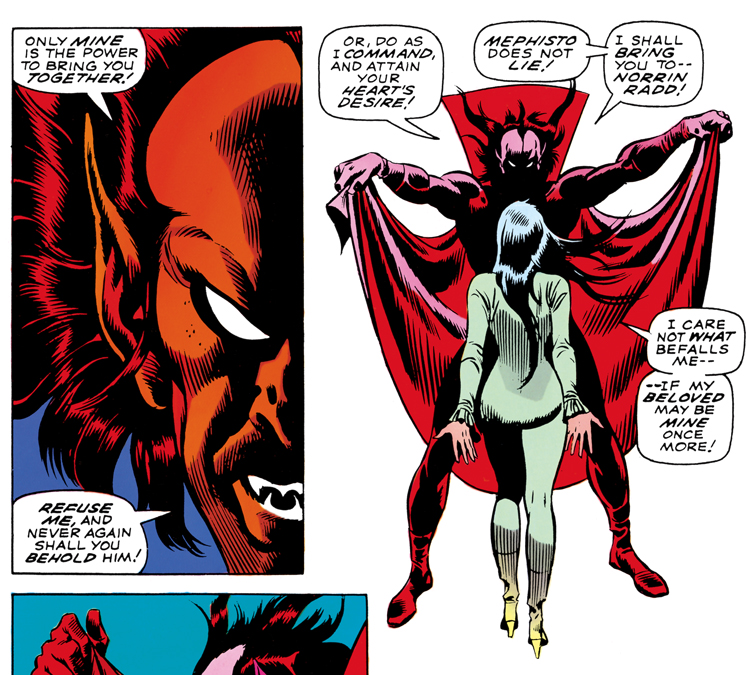
But around the end of the 1960s/beginning of the 1970s, some writers and artists started wanting to explore the morality of comics with some level of complexity. At the same time, the Comics Code Authority started lifting some of the bans they'd had on supernatural characters, which led creators to stretch their boundaries some more.
At the same time, however, comic fans had matured. They'd grown up with characters who got their powers from Heck or fought the powers of Hades. And while they wanted to see their characters get more complex, the morality of the characters get more nuanced and adult, they also believed in the sanctity of the stories that came before.
So, while still toeing a Judeo-Christian line (as that's the ethic that pervades Western superhero comics, so that even Supergirl, after being erased by a cosmic meta-fictional entity, could show up and tell a ghost created by a pseudo-Hindu god what the meaning of Christmas was...)

Both DC and Marvel have quietly become polytheistic universes, without quite admitting or understanding it. It's like how pagan gods got co-opted by early Catholics, transformed into non-canonical saints and martyrs, or how even real saints took the place of sprites/demons/fairies/household gods in the minds of the medieval peasantry.
But hey, as a result, we can have comics where a magician gets almost killed by Satan's bastard son and then learns the secrets of the Druids from some Tibetan lamas. So there's that.
* OTOH, Galactus was supposed to be from some sort of higher plane of existence, which was destroyed by entropy, and was transformed by the shift in planes. So he actually does have a start and end date, being co-terminal with the Marvel universe instead of preceding it. And if any of you have ever read anything of Medieval philosophy and theology, you know why that's a big deal.
** For those of you new to this aspect of Dr. Doom, his mother ending up in hell had more to do with an actual deal with the devil rather than some sort of high-handed "how dare you not go to the right church" kind of thing.
*** Yes. He was a superhero in spandex and a cape, who fought evil with powers he got from being the son of the Devil. Which has to be the worst superhero origin story ever.
For example, in the Marvel universe, you've got the Norse and Greek pantheons, who have their own afterlives (Hel running Valhalla, Pluto running the Olympian underworld) and own special cosmology. At the same time, there is also a group called the Eternals who are clearly the basis of many of the Marvel universe's legends (and, by extension, ours) who were created by a group of alien intelligences called the Celestials who exist on a cosmological plane with a lot of other vague cosmically powered beings such as the In-Betweener, the Beyonder, the Watcher, and Galactus.*
See, he's a Norse demi-god fighting the forces of Hell with a machine gun.
Makes perfect sense, right?
And there is still a Judeo-Christian cosmology and afterlife, since, for example, Doctor Doom's mother is a gypsy trapped in Hell who he frequently tried to rescue**. These afterlives might co-exist/be the same aspect of the occasional place-holder concepts meant to avoid literally saying the words Hell and/or God, etc in a mainstream publication aimed at kids. So, therefore, you have characters like Mephisto (who is clearly the Devil) at the same time as having a character whose name is Son of Satan who is the son of the actual (Judeo-Christian) Satan.***
Bet you didn't know you could defeat the Devil if you just combined science & sorcery!
Now, this kind of confusion is not intentional. A lot of the problem goes back to the fact, originally, that a lot of these comics were written in an age where Judeo-Christianity was assumed to be practiced by most people in America WHILE, at the same time, it was considered offensive or improper for low culture especially to name or reference religion. And more importantly, a lot of these characters were supposed to be aimed at kids or teenagers, and very few people want a young person's religious education to be from a SILVER SURFER comic (though whether their normal religious education is actually any better thought out or put-together than a given SILVER SURFER comic is a question rarely asked.)
See, you can trust him because he's definitely not the Devil. Definitely not.
But around the end of the 1960s/beginning of the 1970s, some writers and artists started wanting to explore the morality of comics with some level of complexity. At the same time, the Comics Code Authority started lifting some of the bans they'd had on supernatural characters, which led creators to stretch their boundaries some more.
At the same time, however, comic fans had matured. They'd grown up with characters who got their powers from Heck or fought the powers of Hades. And while they wanted to see their characters get more complex, the morality of the characters get more nuanced and adult, they also believed in the sanctity of the stories that came before.
So, while still toeing a Judeo-Christian line (as that's the ethic that pervades Western superhero comics, so that even Supergirl, after being erased by a cosmic meta-fictional entity, could show up and tell a ghost created by a pseudo-Hindu god what the meaning of Christmas was...)

They really couldn't have timed this for Makar Sankrati instead?
Both DC and Marvel have quietly become polytheistic universes, without quite admitting or understanding it. It's like how pagan gods got co-opted by early Catholics, transformed into non-canonical saints and martyrs, or how even real saints took the place of sprites/demons/fairies/household gods in the minds of the medieval peasantry.
But hey, as a result, we can have comics where a magician gets almost killed by Satan's bastard son and then learns the secrets of the Druids from some Tibetan lamas. So there's that.
* OTOH, Galactus was supposed to be from some sort of higher plane of existence, which was destroyed by entropy, and was transformed by the shift in planes. So he actually does have a start and end date, being co-terminal with the Marvel universe instead of preceding it. And if any of you have ever read anything of Medieval philosophy and theology, you know why that's a big deal.
** For those of you new to this aspect of Dr. Doom, his mother ending up in hell had more to do with an actual deal with the devil rather than some sort of high-handed "how dare you not go to the right church" kind of thing.
*** Yes. He was a superhero in spandex and a cape, who fought evil with powers he got from being the son of the Devil. Which has to be the worst superhero origin story ever.
Wednesday, July 27, 2011
Writer makes disappointing directorial debut. Also, dog bites man...
STITCHED (2011)
Directed by Garth Ennis
Starring Tank Jones, Lauren Alonzo, and Kate Kugler
Synopsis: The survivors of a crashed American chopper in Afghanistan face a greater threat than the Taliban when they are set upon by a seemingly invulnerable army of the undead. And then the SAS shows up...
I blow hot and cold on Garth Ennis. On the one hand, he has written some great and compelling comics (Punisher: The End, Punisher: The Tyger, Preacher, Hitman). On the other hand, he's a writer whose aesthetic interests I increasingly find hard to separate from his limitations. He writes the foul-mouthed badass & the strong, stoic man of action very well, but writes characters he doesn't agree with or respect as the most contemptible straw men. And sometimes his admiration of tough men making hard choices easily shades into fascism.
So, Garth Ennis making his directorial debut on a short film about soldiers in Afghanistan encountering a supernatural power more evil than the Taliban? Oh, and produced by the people at Avatar (a company that, for every good book it puts out, puts out seventeen stolen from Warren or Alan or Garth's commonplace books)? If it wasn't for the fact that chances to see this outside of Comicon were going to be rare, I probably wouldn't have lined up for it. And a small part of me hoped that Ennis, pushed into a new medium, out of his comfort zone, might do something interesting.
Unfortunately, Stitched isn't even an intriguing misfire. It's just a bore.
The writing isn't the problem, though what comes across on the comics page as clever exposition feels awkward coming out of a real person's mouth sometimes.
The bigger problem is that Ennis just doesn't have a grasp on how to do film. His time as a comic book writer has clearly taught him how to think visually, but the fact he doesn't have to execute those visuals means that good ideas are botched. The carnage of a previous battle that the soldiers stumble across is filmed in such a flat, matter-of-fact way that it comes across as a joke more than a horrific moment. And not a dark joke, but a Zucker-Abrams-Zucker joke.
A better example is a sequence of the soldiers climbing a hill. The soldiers are shot from behind and below as they ascend. It's a good idea either to sell the tiring nature of their trek or to give a mythic image to these tired warriors. In practice, the shot is framed and lit with the minimum amount of attention possible, and instead looks like a series of asses jouncing up a hill.
But the biggest problem is that Ennis can't direct actors. While it's hard to assess from the IMDB resumes of the stars how talented they are, the fact that all the line-readings are given with a similar lack of inflection, as if the scripts were handed to them five minutes before the shoot started and they were told this was merely a read-through. While Jones and Alonzo are poor actors, a special Razzie should be given to Kugler, who manages the amazing feat of being both dull and infuriating in her portrayal of a shellshocked PTSD soldier as a whiny teenager whose parents aren't letting her go to the mall.
Note to directors: stylized dialogue requires special attention to actors to make it work. Note to Garth Ennis: your dialogue is stylized.
If I sound so annoyed, it's because the monsters at the center of the short film are so fascinating. They're similar to zombies in that they are slow, stupid and can't use tools. And like traditional zombies, they're dangerous due to their numbers and tenacity as much as anything. But the visual, of creatures with every hole in their face (eyes, nose & mouth) stitched shut, who stumble along like the Templars from Tombs of the Blind Dead, is amazing. And Ennis' conceptual twists on these creatures (they can't be killed with a shot to the head or severing of the spine, for example) suggest a fascinating mythology.
But all of that is hidden inside a boring, indifferent film whose main purpose, at this point, is to serve as an extended trailer for the inevitable Avatar Press ongoing. Color me unimpressed.
Directed by Garth Ennis
Starring Tank Jones, Lauren Alonzo, and Kate Kugler
Synopsis: The survivors of a crashed American chopper in Afghanistan face a greater threat than the Taliban when they are set upon by a seemingly invulnerable army of the undead. And then the SAS shows up...
I blow hot and cold on Garth Ennis. On the one hand, he has written some great and compelling comics (Punisher: The End, Punisher: The Tyger, Preacher, Hitman). On the other hand, he's a writer whose aesthetic interests I increasingly find hard to separate from his limitations. He writes the foul-mouthed badass & the strong, stoic man of action very well, but writes characters he doesn't agree with or respect as the most contemptible straw men. And sometimes his admiration of tough men making hard choices easily shades into fascism.
So, Garth Ennis making his directorial debut on a short film about soldiers in Afghanistan encountering a supernatural power more evil than the Taliban? Oh, and produced by the people at Avatar (a company that, for every good book it puts out, puts out seventeen stolen from Warren or Alan or Garth's commonplace books)? If it wasn't for the fact that chances to see this outside of Comicon were going to be rare, I probably wouldn't have lined up for it. And a small part of me hoped that Ennis, pushed into a new medium, out of his comfort zone, might do something interesting.
Unfortunately, Stitched isn't even an intriguing misfire. It's just a bore.
The writing isn't the problem, though what comes across on the comics page as clever exposition feels awkward coming out of a real person's mouth sometimes.
The bigger problem is that Ennis just doesn't have a grasp on how to do film. His time as a comic book writer has clearly taught him how to think visually, but the fact he doesn't have to execute those visuals means that good ideas are botched. The carnage of a previous battle that the soldiers stumble across is filmed in such a flat, matter-of-fact way that it comes across as a joke more than a horrific moment. And not a dark joke, but a Zucker-Abrams-Zucker joke.
A better example is a sequence of the soldiers climbing a hill. The soldiers are shot from behind and below as they ascend. It's a good idea either to sell the tiring nature of their trek or to give a mythic image to these tired warriors. In practice, the shot is framed and lit with the minimum amount of attention possible, and instead looks like a series of asses jouncing up a hill.
But the biggest problem is that Ennis can't direct actors. While it's hard to assess from the IMDB resumes of the stars how talented they are, the fact that all the line-readings are given with a similar lack of inflection, as if the scripts were handed to them five minutes before the shoot started and they were told this was merely a read-through. While Jones and Alonzo are poor actors, a special Razzie should be given to Kugler, who manages the amazing feat of being both dull and infuriating in her portrayal of a shellshocked PTSD soldier as a whiny teenager whose parents aren't letting her go to the mall.
Note to directors: stylized dialogue requires special attention to actors to make it work. Note to Garth Ennis: your dialogue is stylized.
If I sound so annoyed, it's because the monsters at the center of the short film are so fascinating. They're similar to zombies in that they are slow, stupid and can't use tools. And like traditional zombies, they're dangerous due to their numbers and tenacity as much as anything. But the visual, of creatures with every hole in their face (eyes, nose & mouth) stitched shut, who stumble along like the Templars from Tombs of the Blind Dead, is amazing. And Ennis' conceptual twists on these creatures (they can't be killed with a shot to the head or severing of the spine, for example) suggest a fascinating mythology.
But all of that is hidden inside a boring, indifferent film whose main purpose, at this point, is to serve as an extended trailer for the inevitable Avatar Press ongoing. Color me unimpressed.
Wednesday, July 20, 2011
Stop talking about comic books or I'll kill you...
I'm heading to Comicon. Posting to resume after I return!
Thursday, July 7, 2011
A Quick Appreciation of Stan Lee....
So I'd been feeling burned out with comic books lately for several reasons (which will be the subject of a later post). Luckily, I decided to dig out those black & white phone book-style reprints of Kirby's Thor & New Gods that Marvel and DC put out about ten years ago. I've always been a big Kirby fan and I even enjoy his late period stuff, which is certainly flawed, but has a wonderful energy.
Still, you can never go wrong reading/looking at Kirby's Marvel work in the mid-'60s and the first flowering of his Fourth World stories. He's not stretched quite as thin as he was in the early '60s when he worked on every Marvel book (it seems like) and he's not burned out or saddled with corporate remits the way he was after DC canceled the Fourth World books. There's a real sense that he's challenging himself in every issue to do something new with character designs or layouts or fight scenes. And on Thor, Vince Colletta's much-maligned inking is very beautiful. Even if he did erase or ignore the detail of Kirby's pencils, Colletta's thin brush strokes give Kirby's pencils a newspaper adventure strip feel (like Prince Valiant).
Kirby's always worth checking out, but New Gods and his run on Thor as it transitioned from Journey Into Mystery into Thor are amazing.
But one thing I noticed, reading the two back-to-back, is the differences between Kirby's work with Stan Lee and Kirby's solo work. Both periods have plenty of fans and supporters, and I enjoy both.
The thing that emerges from his work with Stan Lee on Thor is how the characterization is more subtle and grounded. Kirby's bombast and melodrama have their charms (and Stan Lee certainly wrote his share of melodrama), but he's not one for nuance. While Orion, upon rereading New Gods, certainly is quite complex (the irony that New Genesis relies on the rage and fierceness Orion inherited from Darkseid to defend themselves from Darkseid is acknowledged quite well), outside of Terrible Turpin, none of the human characters really register. They keep getting crowded out by all the superhumans.
Whereas in Thor, even the walk-ons end up making an impression. There's a sequence where Thor takes a cab to escape a crowd and ends up having a really frank heart-to-heart with the driver. It's a very nice moment, but the capper is, after Thor leaves, the driver's next fare asks him if that's really Thor.
The driver, who from the previous exchange we've seen is a humble, friendly guy. But he can't help but half-brag/half-joke that Thor takes his cab all the time, that they're old pals. And then, he ruefully adds, Thor forgot to pay his fare.
Lee and Kirby together, through the dialogue and art, get across the complexity of this exchange very well. The cab driver comes across as a complex person, and it really illuminates Thor's character as well. Thor has "the common touch", unlike many of his fellow immortals, but even he can lose sight of the details.
What's really impressive about Thor is how funny it can be. Lee has a good touch for leavening the bombast, when it threatens to get too overwhelming. Volstagg's presence keeps Asgard from feeling too cold or inhuman, for example.
I know the attribution of what Kirby and Lee brought to their collaborations is always very tenuous. It's tempting to ascribe to Kirby a lot of what made their collaboration great, both because of Lee's boosterism at the expense of his collaborators and Lee's lack of creative success post-Kirby & Ditko. I think most people, given the choice, would put rather Mister A or Captain Victory on their resume than Ravage 2099 or Stripperella.
But Lee did bring something to Kirby's work. At the very least, he pushed Kirby out of his comfort zone as a co-writer, forcing him to deal with characters and emotions that Kirby preferred to avoid in his solo work.
Still, you can never go wrong reading/looking at Kirby's Marvel work in the mid-'60s and the first flowering of his Fourth World stories. He's not stretched quite as thin as he was in the early '60s when he worked on every Marvel book (it seems like) and he's not burned out or saddled with corporate remits the way he was after DC canceled the Fourth World books. There's a real sense that he's challenging himself in every issue to do something new with character designs or layouts or fight scenes. And on Thor, Vince Colletta's much-maligned inking is very beautiful. Even if he did erase or ignore the detail of Kirby's pencils, Colletta's thin brush strokes give Kirby's pencils a newspaper adventure strip feel (like Prince Valiant).
Kirby's always worth checking out, but New Gods and his run on Thor as it transitioned from Journey Into Mystery into Thor are amazing.
But one thing I noticed, reading the two back-to-back, is the differences between Kirby's work with Stan Lee and Kirby's solo work. Both periods have plenty of fans and supporters, and I enjoy both.
The thing that emerges from his work with Stan Lee on Thor is how the characterization is more subtle and grounded. Kirby's bombast and melodrama have their charms (and Stan Lee certainly wrote his share of melodrama), but he's not one for nuance. While Orion, upon rereading New Gods, certainly is quite complex (the irony that New Genesis relies on the rage and fierceness Orion inherited from Darkseid to defend themselves from Darkseid is acknowledged quite well), outside of Terrible Turpin, none of the human characters really register. They keep getting crowded out by all the superhumans.
Whereas in Thor, even the walk-ons end up making an impression. There's a sequence where Thor takes a cab to escape a crowd and ends up having a really frank heart-to-heart with the driver. It's a very nice moment, but the capper is, after Thor leaves, the driver's next fare asks him if that's really Thor.
The driver, who from the previous exchange we've seen is a humble, friendly guy. But he can't help but half-brag/half-joke that Thor takes his cab all the time, that they're old pals. And then, he ruefully adds, Thor forgot to pay his fare.
Lee and Kirby together, through the dialogue and art, get across the complexity of this exchange very well. The cab driver comes across as a complex person, and it really illuminates Thor's character as well. Thor has "the common touch", unlike many of his fellow immortals, but even he can lose sight of the details.
What's really impressive about Thor is how funny it can be. Lee has a good touch for leavening the bombast, when it threatens to get too overwhelming. Volstagg's presence keeps Asgard from feeling too cold or inhuman, for example.
I know the attribution of what Kirby and Lee brought to their collaborations is always very tenuous. It's tempting to ascribe to Kirby a lot of what made their collaboration great, both because of Lee's boosterism at the expense of his collaborators and Lee's lack of creative success post-Kirby & Ditko. I think most people, given the choice, would put rather Mister A or Captain Victory on their resume than Ravage 2099 or Stripperella.
But Lee did bring something to Kirby's work. At the very least, he pushed Kirby out of his comfort zone as a co-writer, forcing him to deal with characters and emotions that Kirby preferred to avoid in his solo work.
Tuesday, May 3, 2011
A special treat for Mr. K fans...
I fly to Chicago tomorrow. I'm going to be gone for a week, and probably without internet access for most of that week.
But I do have a special treat for you. I was volunteering at Cinefamily last week for a special event they did with clothing label Stussy. They screened Punisher: War Zone and clips from a bunch of obscure Marvel multimedia (including the Japanese live-action Spider-Man and that Turkish film where Captain America and El Santo are pursuing an evil Spider-Man). I got some neat Stussy-designed pins of Marvel Comics characters and they took some pictures.
I'm the guy in the blue polo shirt and khakis midway down the page. Too bad you can't see those pins. They're pretty awesome.
But I do have a special treat for you. I was volunteering at Cinefamily last week for a special event they did with clothing label Stussy. They screened Punisher: War Zone and clips from a bunch of obscure Marvel multimedia (including the Japanese live-action Spider-Man and that Turkish film where Captain America and El Santo are pursuing an evil Spider-Man). I got some neat Stussy-designed pins of Marvel Comics characters and they took some pictures.
I'm the guy in the blue polo shirt and khakis midway down the page. Too bad you can't see those pins. They're pretty awesome.
Sunday, April 3, 2011
Profiles in awesomeness...
Okay, this isn't really a profile per se, as me taking a moment to give thanks I live in Los Angeles because it enables me to see all manners of awesomeness by awesome people.
James Jean, the artist responsible for amazing covers for series such as Fables & Umbrella Academy, has a gallery show here in LA that closes April 30th. It's at the Martha Otero Gallery at 820 N Fairfax.
I plan to check it out very soon. I encourage all my fellow Angelenos to do the same.
James Jean, the artist responsible for amazing covers for series such as Fables & Umbrella Academy, has a gallery show here in LA that closes April 30th. It's at the Martha Otero Gallery at 820 N Fairfax.
I plan to check it out very soon. I encourage all my fellow Angelenos to do the same.
Sunday, March 13, 2011
Sci-fi tropes that need to be banned for 50 years...
I had a serious post half-written about how I'm somewhat tired of the sci-fi genre. And then I realized it would probably be more helpful/fun to make a post of sci-fi tropes/plot devices that need to be banned for at least the next 50 years.
Clearly I'm not a governing body with any kind of authority, so, think of it this way. If you are writing something in which any of the following things are used, just think twice about it. Are you really writing something that original?
Clearly I'm not a governing body with any kind of authority, so, think of it this way. If you are writing something in which any of the following things are used, just think twice about it. Are you really writing something that original?
- Despite being the distant future, America still exists pretty much like it does now, both geographically and sociologically.
- Despite being the distant future, America's main political/military rivals are still exactly the same as they are today.
- Despite being the future, the one world government is run suspiciously like a US-style democracy, and most of the leaders seem to be white and/or male.
- Despite being the distant future with high technological advancement, the roles of men and women are exactly the same. If they are being disputed, it is in the same way they are currently being disputed.
- Mankind has encountered only one alien race, and they are monolithically united in fighting us.
- The morality of totally wiping out a sentient race is never questioned, or only by a straw man.
- Mankind is technologically set back by a disaster. It responds by adapting SCA/medieval political units, with no alterations.
- When mankind loses technology and forms a quasi-utopian pre-Industrial society, no one ever requires internal medicine or modern pharmaceuticals.
- Despite major technical advances, including mass teleportation, mankind still relies on 19th/early 20th naval tactics for warfare. Especially in space.
- The Nazis/Confederates win World War II/the Civil War.
- The Nazis/Confederates win World War II/the Civil War with the aid of time travelers/aliens/dragons.
- A quasi-fascist strong man is the only one who can save the Future US/Earth from a major threat. Anyone who questions him is completely wrong.
- Except for uniforms that look like Iron Man joining a SWAT team, average soldiers are completely the same as the stock types from a World War II movie.
- Sexual relations and mores are exactly the same as they are currently.
Ok, this is just a start. If you have more suggestions, leave them in the comments.
Sunday, February 27, 2011
Spy versus spy (Joseph Losey division)
Modesty Blaise (1966)
d. Joseph Losey
Starring: Monica Vitti, Terrence Stamp, Dirk Bogarde, and Clive Revill
If there is one silver lining to wearying but banal illnesses like a cold or the flu, it is the way they justify catching up on one's movie viewing, especially lightweight cinematic confections. I might not be interested in watching Salo right now, but something like Modesty Blaise or a giallo or a minor '40's b-movie is right up my alley.
And Modesty Blaise is good. Not great, but definitely good. From the buzz (or lack of it), I expected to find something like the atrocious 1967 version of Casino Royale. Instead, it could sit comfortably alongside Mario Bava's Danger: Diabolik. Just like Bava's film, MB is a comic book caper that is definitely more style than substance, but that style...
d. Joseph Losey
Starring: Monica Vitti, Terrence Stamp, Dirk Bogarde, and Clive Revill
If there is one silver lining to wearying but banal illnesses like a cold or the flu, it is the way they justify catching up on one's movie viewing, especially lightweight cinematic confections. I might not be interested in watching Salo right now, but something like Modesty Blaise or a giallo or a minor '40's b-movie is right up my alley.
And Modesty Blaise is good. Not great, but definitely good. From the buzz (or lack of it), I expected to find something like the atrocious 1967 version of Casino Royale. Instead, it could sit comfortably alongside Mario Bava's Danger: Diabolik. Just like Bava's film, MB is a comic book caper that is definitely more style than substance, but that style...
Tuesday, December 21, 2010
Wrapping yourself in the flag...
Over on the newly revived Unplanned Misadventures of Mirmir and Bess (come for the anecdotes of fun adventures, stay for the feminist/anti-imperialist dissection of nerdery), Miriam dissects the white supremacist boycott of THOR very well, but I wanted to respond to the fact that she's never been a fan of Captain America.
And that's because Captain America's adventures are probably consistently the most politically complex of any Marvel superhero.
I think Marvel has always known that Cap as a character is loaded with political significance, both due to his wartime popularity and the way he stands for America. Unlike a lot of other "patriotic" heroes who had cute names or historical inspirations, his name proclaims that he represents America. Which immediately
And writers for Marvel certainly figured this out relatively early. While Green Lantern was awkwardly trying to prove that he was concerned about the inner-city when not fighting Sinestro (in what reads now as a Guess Who's Coming to Dinner? argument for tolerance), writers of Cap grappled with more complex issues.
Steve Englehart's run in the early 70s (collected here and here
 ), though sometimes clumsily and earnestly written, was an incredibly ambitious attempt to grapple with the problems of post-Vietnam/Watergate America. Cap acquired a black sidekick from the inner-city who disagreed with Cap's more conservative views. Cap encountered an insane anti-Communist imitator who embodied the worst of 1950s McCarthyism. And he faced a conspiracy led by the Committee to Re-establish America's Principles (just read the bolded words), a clear attack on Nixon's Committee to Re-Elect the President, which attacked Cap as a left-wing radical for his moderate views. Englehart's first major storyline culminated in a showdown at the White House where a shadowy figure in the Oval Office committed suicide to avoid paying for his crimes against the American people.
And in the 80s, while DC's British Invasion pushed forward the subject matter and tone of comics, Mark Gruenwald's run on Captain America and Squadron Supreme tried to do the same for Marvel's titles. While Squadron Supreme certainly deserves further examination, Gruenwald's attempts to engage with Reagan's "Morning in America" in Cap are also quite canny.
Gruenwald's most important political storyline was one where a Senate Subcommittee decided that Captain America's political loyalties were way too nuanced and unreliable and that Steve Rogers (Cap's alter-ego) had to be replaced by someone else. The irony that a man who fought Nazis in World War II was insufficiently patriotic for Reagan's America was subtly underplayed.
In the ensuing storyline, the Senate selects a character named the Superpatriot to replace Steve Rogers. He gets the job after all sorts of staged and falsely spun PR antics that show him as more "law and order" than Cap. As the storyline unfolded, John Walker (the new Cap) proved himself to be more brutal and less competent than his predecessor and easily manipulated by his enemies. In the end, it falls to Steve Rogers and his more compassionate/moderate left style to save the world where the jingoistic Reaganite asshole failed.
This barely scratches the surface of the ways Cap's been used to comment on America's view of itself and how we define the ideal American. Some of these stories are clunky, especially compared to the more stripped-down "realist" style most superhero comics prefer these days, but they do make ambitious attempts to grapple with America the ideal versus America the reality.

And that's because Captain America's adventures are probably consistently the most politically complex of any Marvel superhero.
I think Marvel has always known that Cap as a character is loaded with political significance, both due to his wartime popularity and the way he stands for America. Unlike a lot of other "patriotic" heroes who had cute names or historical inspirations, his name proclaims that he represents America. Which immediately
And writers for Marvel certainly figured this out relatively early. While Green Lantern was awkwardly trying to prove that he was concerned about the inner-city when not fighting Sinestro (in what reads now as a Guess Who's Coming to Dinner? argument for tolerance), writers of Cap grappled with more complex issues.
Steve Englehart's run in the early 70s (collected here
and here), though sometimes clumsily and earnestly written, was an incredibly ambitious attempt to grapple with the problems of post-Vietnam/Watergate America. Cap acquired a black sidekick from the inner-city who disagreed with Cap's more conservative views. Cap encountered an insane anti-Communist imitator who embodied the worst of 1950s McCarthyism. And he faced a conspiracy led by the Committee to Re-establish America's Principles (just read the bolded words), a clear attack on Nixon's Committee to Re-Elect the President, which attacked Cap as a left-wing radical for his moderate views. Englehart's first major storyline culminated in a showdown at the White House where a shadowy figure in the Oval Office committed suicide to avoid paying for his crimes against the American people.And in the 80s, while DC's British Invasion pushed forward the subject matter and tone of comics, Mark Gruenwald's run on Captain America and Squadron Supreme
tried to do the same for Marvel's titles. While Squadron Supreme certainly deserves further examination, Gruenwald's attempts to engage with Reagan's "Morning in America" in Cap are also quite canny.Gruenwald's most important political storyline
was one where a Senate Subcommittee decided that Captain America's political loyalties were way too nuanced and unreliable and that Steve Rogers (Cap's alter-ego) had to be replaced by someone else. The irony that a man who fought Nazis in World War II was insufficiently patriotic for Reagan's America was subtly underplayed.In the ensuing storyline, the Senate selects a character named the Superpatriot to replace Steve Rogers. He gets the job after all sorts of staged and falsely spun PR antics that show him as more "law and order" than Cap. As the storyline unfolded, John Walker (the new Cap) proved himself to be more brutal and less competent than his predecessor and easily manipulated by his enemies. In the end, it falls to Steve Rogers and his more compassionate/moderate left style to save the world where the jingoistic Reaganite asshole failed.
This barely scratches the surface of the ways Cap's been used to comment on America's view of itself and how we define the ideal American. Some of these stories are clunky, especially compared to the more stripped-down "realist" style most superhero comics prefer these days, but they do make ambitious attempts to grapple with America the ideal versus America the reality.
Englehart uses Cap to grapple with Watergate.
(Thanks, Paul Constant for the image.)
Sunday, October 31, 2010
This is not my brother...
Your Halloween treat for today, one of the most unsettling horror comics I've read in months:
His Face All Red by Emily Carroll.
Trust me, no matter what kind of horror you like, you'll enjoy it.
His Face All Red by Emily Carroll.
Trust me, no matter what kind of horror you like, you'll enjoy it.
Wednesday, March 11, 2009
The Abyss Gazes Also; or, Alan Moore Knows the Score
Long time, no blog, I know. Mr. K has been a bad blogger, especially in our brave new world with a comic book collecting president and a #1 comic book movie ruling the box offices. I swear I've got ideas kicking around, but it didn't feel urgent to review Watchmen, especially since everyone else has already said all the things I'd ever want to say, both good and bad (Mr. Walton at Picture Poetry sums up some of my feelings re: my ambivalence to Watchmen the movie as an adaptation of Watchmen the book).
One thing I did want to remark on was that for years Alan Moore has feared that people will only see adaptations of his work and totally misunderstand his actual work. I've always thought this was absurd, that intelligent people at least wouldn't dismiss his body of literature based on a movie version. That's like saying Hamlet was stupid and immature because you didn't like Kenneth Branaugh's film version, right?
But then the media and the blogosphere seem determined to prove me wrong. As far as the AO Scott article that Isaac at Parabasis references, I think he does a good enough job of taking down the laziness. But the Freddie deBoer post has so many things wrong about it.
First of all, I can't tell if Freddie deBoer has ever ACTUALLY READ THE BOOK before he started bashing Alan Moore. Because he blames the entire content of the book on Alan Moore, who apparently also pencilled, inked, colored and edited the graphic novel all by himself. Read the article again. You know who Freddie deBoer never references?
DAVE GIBBONS. The only creator that the movie actually credits with putting together Watchmen. The artist responsible for the look of the world of the comic, whose actual panels were the basis for several shots of the film. The man who Zach Snyder, the director of the film itself, met with for guidance. Also, an artist who collaborated with Alan Moore on several other projects and has also written comics solo. He's no work-for-hire hack that Moore dictated everything too.
This suggests to me that Freddie read the graphic novel (if he read it at all) as a NOVEL, ignoring, you know, the graphic part? Furthermore, it suggests to me that Freddie saw the film and remembered Alan Moore had something to do with it, remembered he had some poorly-reasoned dislike of Alan Moore and decided, hey, it's time for a blog post.
Because, hey, want to know something else? For all Freddie lumps the book with the film and disses Alan Moore, he never suggests that someone else directed the film, with a bunch of actors and designers who were also not Alan Moore, with a lot of final decisions regarding editing and marketing made by business executives not named Alan Moore. I've heard of the intentional fallacy, but this is the first time I've seen the only intent ascribed to someone who was desperate to disassociate himself from the actual film and only generated the original work it was based on!
And he talks about the ridiculous violence and cruelty of the movie (which was problematic) and elides it with a book that mostly avoids showing violence and cruelty on the page.
Do we actually see the Comedian impact on the pavement? Do we see the dogs actually murdered or the little girl molested and fed to the dogs? (And note, these are things that neither the graphic novel or the movie actually show! )
And, sure, Freddie can say that the movie didn't have to deal with the awful violent subjects it continually suggests. And that might be fair, because the movie often slows to down to let you enjoy the violence because skull getting split is kewl!
But to blame the graphic novel for that? To say that, one of the only comic books that I've ever seen subject one of its biggest murderers to rigorous psychological examination, a graphic novel that continually ironizes (visually and textually) the idea that violence solves anything, a story which positions a passer-by trying to stop someone from abusing their lover on the street as more heroic than the costumed heroes supposed to protect him, to say that comic book is immature and pretentious is the mark of a shallow and superficial reader who needs his sentiments spoon-fed to him!
And that's even leaving out the fact that every death in Watchmen has a consequence, that we see it weigh on the characters in the art, that we see seemingly unconnected people having to cope with the aftermath of each death. Go back to the graphic novel and think about Nite Owl II's feelings of guilt over the policeman critically injured by a device he invented even though Rorschach pulled the trigger. Go reread the scenes where Malcolm Long's marriage and life are torn apart in his quest to understand what drove his patient to violence, even though his own life and behavior are perfectly exemplary. If you can't stick it out that far, take a look at the first chapter of Under the Hood that closes out issue one, where Hollis Mason remembers and feels shame over the suicide of a cuckolded man he once laughed at. People in this book take responsibility for the violence that takes place, even if they don't always respond the right way or even if they're not to blame.
Watchmen is a work that drips empathy for almost every character, so that by the end we feel sad to see a sociopathic vigilante murdered in the snow. Moore even makes a sympathetic, progressive character whose views most mirror Moore's politics the ultimate villain, while making a reprehensible, xenophobic right-wing tabloid the voice of truth!
But what can you expect from a writer whose idea of an argument against Lars Van Trier is that he's full of shit? So? That doesn't say anything about how his work mirrors or fails to mirror life. It tells me nothing about why his movies should be relegated to some historical dustbin.
So instead he complains about Alan Moore lacking delicacy and tact and the low critical bar that graphic novels have to leap. Maybe he should instead be glad for the even lower bar set for bloggers.
Wednesday, November 5, 2008
Two updates in two days? This is not change you should believe in...
In a mostly "eh" week of comics, Secret Six #3 reminded me why I read monthly superhero comics.
After an acceptable but not overwhelming issue, our six supervillains, hired by a mysterious benefactor to retrieve former metahuman Tarantula and a Macguffin, find out what the Macguffin is. And suddenly, an issue filled with (seeming) non-sequiturs from supervillains on all the evil stuff they've done makes sense and a bunch of discussions/thoughts on redemption throughout the series take on extra narrative weight. Simone mixes the mystical and noir elements of the DCU to great effect,
If it wasn't rather heavy on DCU-continuity, I'd say it would be the kind of comic Eve Tushnet would love to read and discuss. It might still be, at that.
[SPOILER]
In a well-handled scene, tears trailing down her face, Tarantula reveals that the card she took was created by Neron, the DCU's version of the devil. Written on it in Aramaic is "get out of hell free."
It's adding a religious spin to noir. Instead of everyone wanting one big score or wealth or safety, everyone wants heaven. And they don't care what they have to do to get it.
Friday, October 24, 2008
...But it has zombies in it. How can I not like zombies?
I read Marvel Zombies by Robert Kirkman and Sean Phillips in Borders today and was glad I didn't pick it up either in singles, hardcover or trade. It was competently executed, with one or two good gags (emo zombie Spider-man and "Hulk is the Hungriest Man there is") and a few good disturbing notes (the idea of the zombie Avengers faking rescues to lure out survivors, for example).
But it neither teased out any societal analysis as the best zombie media does (Romero films, Walking Dead, World War Z) or went for all out tastelessness that the most enjoyable gut munchers do (almost any Italian zombie film not made by Fulci, Dead Alive). The only thing approaching subtext was the title: this was a book for Marvel obsessive or zombie obsessives. Unfortunately, I count myself as a zombie obsessive (I've watched Hell of the Living Dead, people. That is not something a sane person undertakes lightly) and I found it as unsatisfying as the morsels of human flesh that fall out of the zombies' own rotten gullets.
Pondering a couple post topics soon: A Defense of Lucio Fulci, a write-up of Act of Violence (with Robert Ryan and Van Heflin) and Mystery Street (with Ricardo Montalban and Charles Laughton's beard), or maybe something about Who Can Kill A Child? (if Netflix comes through).
Subscribe to:
Posts (Atom)